Infographic 10 · ZANISS SOFTWARES

How to Cut Cloud Bills Without Breaking Production

Most cloud bills are 30–40% larger than they need to be — not because the team is careless, but because nobody owns cost. This page covers where cloud overspend actually hides, the right-sizing and pricing-model moves that produce the fastest returns, and the governance changes that make savings stick past month three.

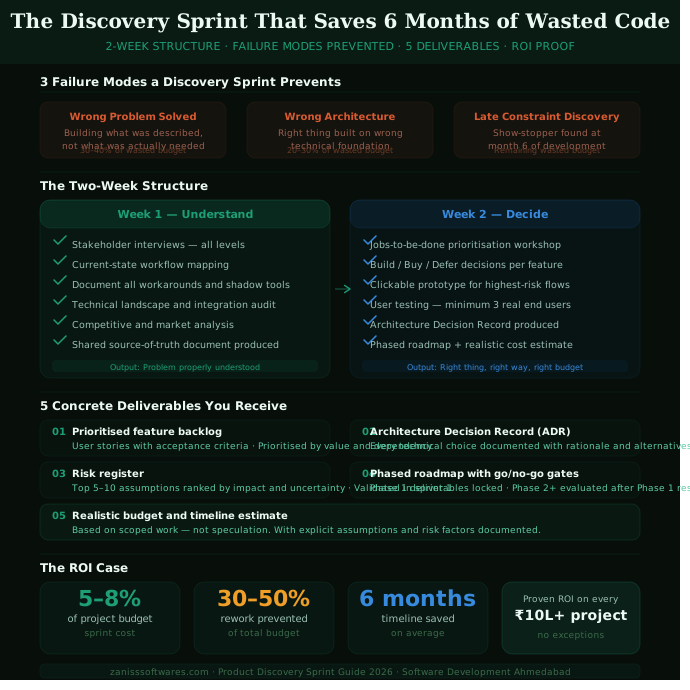
How to Cut Cloud Bills Without Breaking Production — infographic by ZANISS SOFTWARES
How to Cut Cloud Bills Without Breaking Production · Source: ZANISS SOFTWARES — free to share with credit and a link back to this page.

Key takeaways

  • Most organisations overspend on cloud by 30–40% — fixable without engineering downtime
  • Reserved instances and committed use reduce compute costs by 30–60% with zero performance trade-off
  • The three highest-impact actions: right-size to actual utilisation, delete idle resources, switch non-critical batch to spot / preemptible
  • Auto-scaling eliminates over-provisioning for variable workloads — the most common single source of waste
  • A systematic cloud cost audit typically pays for itself within the first month of implemented changes

Where Cloud Overspend Hides

Cloud bills are difficult to read by design — the pricing models for compute, storage, networking, data transfer and managed services interact in ways that make attribution non-obvious. The most common sources of waste are not exotic: over-provisioned instances, idle resources left running by teams that no longer need them, and workloads on on-demand pricing since they were first provisioned two years ago because no one reviewed them. Over-provisioned compute is the largest single category — an instance sized for peak load but running at 15–30% utilisation 90% of the time is paying for capacity never used. AWS Cost Explorer, Google Cloud Recommender and Azure Advisor all provide right-sizing recommendations based on actual utilisation. For most production environments, right-sizing alone reduces the monthly bill by 20–40% with no change to application behaviour.

Idle Resources and Pricing-Model Optimisation — The Highest-Return Actions

Development and staging environments left running over weekends, load balancers pointing to deleted services, unattached storage volumes and orphaned snapshots accumulating at storage cost per GB per month — these are the invisible items that compound on every cloud bill. A systematic resource audit typically surfaces 5–15% of total spend in immediately deletable resources. The organisational cause: no process for decommissioning resources when a project ends. A tagging policy requiring every resource to have an owner and a project tag, combined with a monthly review of resources whose project has closed, prevents recurrence. For anything that has been running continuously for 12+ months — production databases, app servers, Kubernetes nodes — switching to reserved instances, savings plans or committed-use contracts reduces costs by 30–60% with no operational change.

Data Transfer, Storage and the Audit Process

Network data transfer between availability zones and to the public internet generates charges that many engineering teams monitor poorly. Reviewing network topology and co-locating services that communicate frequently can reduce transfer costs meaningfully at scale. Storage lifecycle policies that automatically transition infrequently accessed data to lower-cost tiers — Glacier, Nearline, Cool — can reduce storage costs by 50–80% for archival data without any change to application code. ZANISS SOFTWARES conducts cloud cost audits for businesses on AWS, GCP and Azure. The typical engagement takes two weeks — one week analysis, one week implementation. Typical outcome: 25–45% reduction in monthly cloud spend with zero impact on uptime.

Frequently asked questions

Why are cloud bills so hard to control?
Cloud platforms are designed for frictionless resource creation, which makes it easy to accumulate costs without realising it. The pay-as-you-go model creates hundreds of individual billing line items across compute, storage, networking, and managed services — each individually small but collectively significant. Without tagging, budgets, and regular reviews, costs drift upward unchecked.
What is FinOps and how does it reduce cloud costs?
FinOps is a set of practices that brings financial visibility and accountability to cloud spending. It involves tagging resources by team and environment, setting budget thresholds, reviewing cost anomaly alerts, and making engineering teams responsible for the cost of the resources they use. Organisations that adopt FinOps practices typically reduce cloud waste by 25–40% within the first quarter.
Can I reduce cloud costs without affecting application performance?
Yes. The majority of cloud cost reduction actions — right-sizing over-provisioned instances, purchasing reservations, cleaning up unused resources, and implementing storage lifecycle policies — have no impact on application performance. Auto-scaling configurations actually improve performance under variable load while reducing cost during quiet periods.

Want this applied to your business?

Book a free consultation and we'll map this framework to your project — no fluff, no sales pressure.