Infographic 11 · ZANISS SOFTWARES

Long-Tail Keywords That Convert for B2B Software Companies

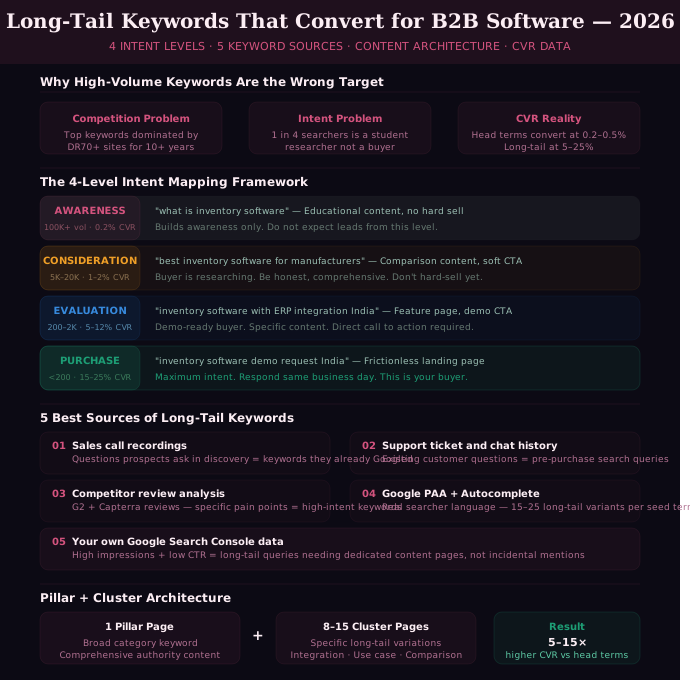
Head terms in B2B software are dominated by global directories — Clutch, GoodFirms, DesignRush — and Tier-1 agencies with 10–20 years of authority. Long-tail is where smaller vendors actually win — at 5–10× the conversion rate. This page shows how to find your highest-value long-tail terms, the formats that work, and the internal-linking structure that compounds.

Long-Tail Keywords That Convert for B2B Software Companies — infographic by ZANISS SOFTWARES
Long-Tail Keywords That Convert for B2B Software Companies · Source: ZANISS SOFTWARES — free to share with credit and a link back to this page.

Key takeaways

  • Long-tail keywords account for 70% of search traffic with fewer competitors — the highest-ROI SEO investment for most B2B software companies
  • A visitor arriving via a specific long-tail query has already self-qualified — they know what they want and are actively looking
  • One well-written long-tail article can generate qualified B2B leads continuously for two to three years
  • Most companies waste effort on high-volume, high-competition terms they cannot rank for instead of specific terms they can own in 90 days
  • Long-tail SEO and Google Ads are complements, not alternatives — content that ranks costs nothing per click; the same keyword in Ads provides immediate traffic

Why Short-Tail Keywords Fail B2B Software Companies

'Software development company' generates enormous search volume in India. It is also dominated by global directories and Tier-1 agencies with 10–20 years of domain authority and thousands of inbound links. A new or growing B2B software company cannot realistically rank on page one for this term within two years of consistent effort. Meanwhile, 'custom ERP software for garment manufacturing companies in Surat' has lower search volume but is searched exclusively by the prospect you want — a procurement manager in a specific industry, in a specific geography, with a specific pain point. That page can be ranked within 60–90 days of publication. Volume is lower, conversion rate is dramatically higher, because the keyword has pre-qualified the visitor before they reach your page.
How to Identify Your Highest-Value Long-Tail Keywords

The most reliable source of your best long-tail keywords is your existing client base. Work backwards from your best-fit clients: what industry were they in? What problem were they searching for a solution to when they found you? What software or process were they trying to replace? What geography were they searching from? Each answer generates a keyword cluster. Supplement client-derived keywords with three tools: Google Search Console (the actual queries bringing traffic), Google Autocomplete (what real users append to your core service terms), and the 'People also ask' and 'Related searches' sections — direct windows into the question clusters your audience is asking. Organise keywords by intent: informational (early), comparison (mid), commercial (late).

Content Formats and the Internal Linking Structure That Compounds

Long-tail SEO content for B2B software performs best in three formats: problem-solution articles (750–1,500 words structured around the specific pain point the keyword represents), comparison pages (your approach versus a specific competitor or category, for the searcher actively evaluating options), and case studies structured around the industry and problem type of the target keyword. Each piece should be self-contained enough to answer the query completely — Google rewards thoroughness — while making clear that deeper application requires professional engagement. Every long-tail article should link to the primary service page it supports and to the consultation booking page. Service pages should link to the most relevant long-tail articles. This creates a content cluster where Google understands the topical relationship between pages, and every educational article flows qualified traffic toward a conversion point.

Frequently asked questions

What are long-tail keywords and why do they matter for B2B?
Long-tail keywords are specific, multi-word search phrases that signal precise buyer intent. For B2B software businesses, they typically combine a product type, industry, use case, or location — such as "cloud ERP for healthcare companies India." They matter because searchers using specific phrases are significantly closer to a purchasing decision than those searching broad terms, making them higher-value leads despite lower search volume.
How do I find long-tail keywords for my software business?
Start with Google Search Console to see what you already rank for, then use Google Keyword Planner or Semrush to expand your keyword list. Look for phrases that combine your service type with an industry, a problem, a geography, or a buyer role. Review "People Also Ask" boxes and Google autocomplete suggestions for your core services — these surface real search phrases from your actual buyers.
Do long-tail keywords really generate more qualified leads?
Yes, consistently. The specificity of a long-tail search phrase is a direct indicator of buyer intent. A visitor who found your website by searching "custom inventory management software for food distributors" has self-identified their industry, their need, and their interest in a custom solution — making them significantly more likely to become a qualified lead than a visitor who searched "inventory software" from a broad, informational mindset.

Want this applied to your business?

Book a free consultation and we'll map this framework to your project — no fluff, no sales pressure.