Quick Summary
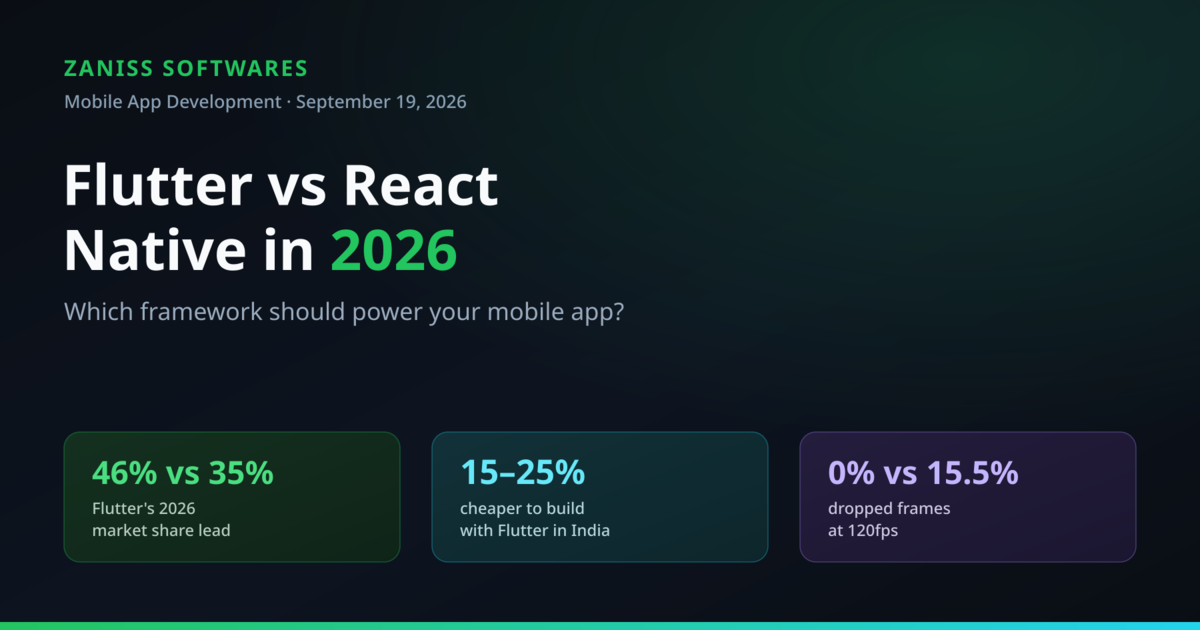
- 1Flutter now holds 46% market share vs React Native's 35% in 2026, reversing React Native's earlier lead — but market share alone shouldn't decide your framework.
- 2Both frameworks got major rewrites: Flutter's Impeller 2.0 rendering engine and React Native's New Architecture (Fabric, TurboModules, JSI, Hermes) closed old performance gaps, but real differences remain.
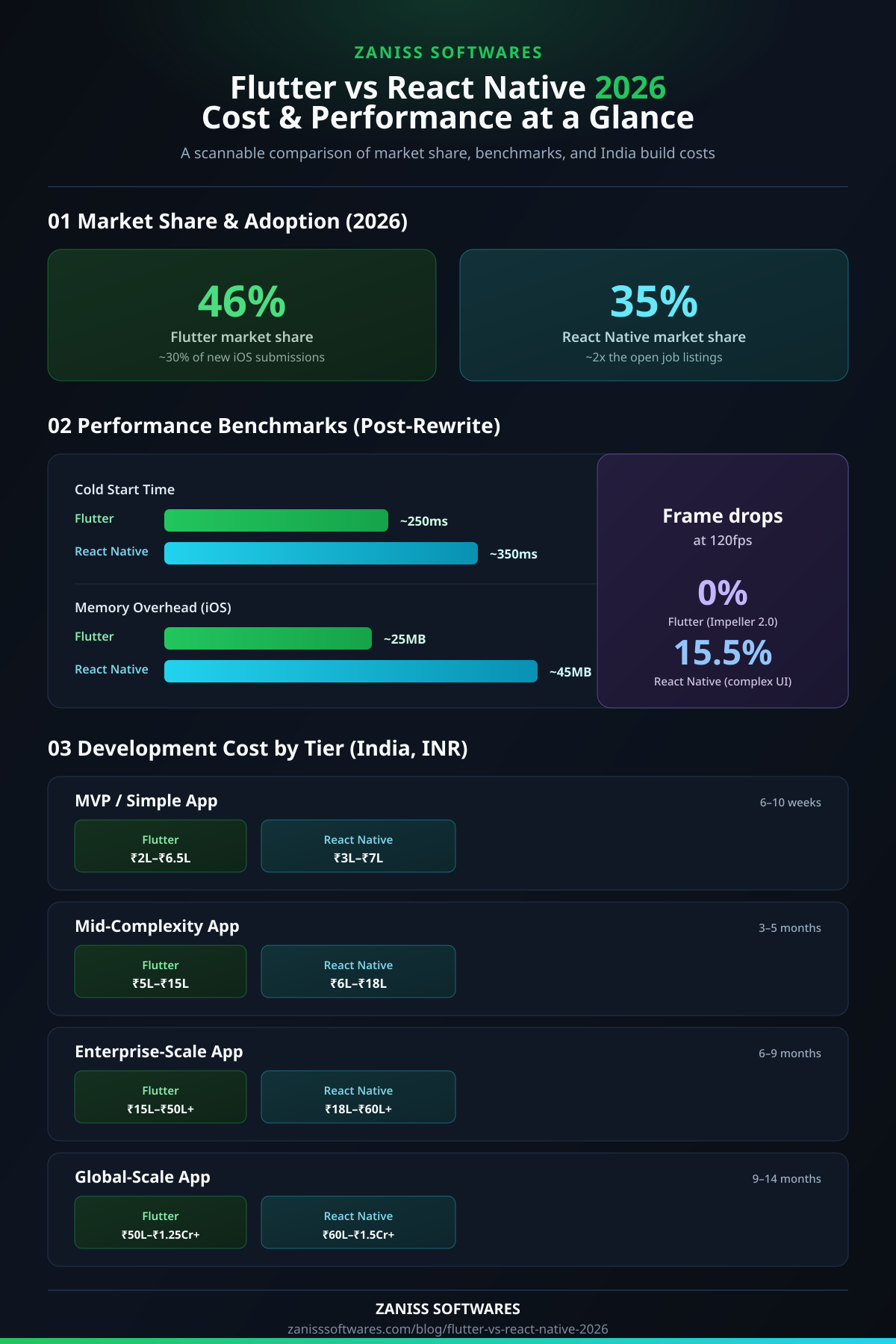
- 3Benchmarks show Flutter cold-starts in ~250ms with 0% dropped frames at 120fps; React Native's New Architecture reaches ~350ms cold starts with ~15.5% frame drops under complex interactions.
- 4Flutter development in India runs 15–25% cheaper than React Native across every project tier, from MVP to enterprise scale.
- 5The right choice depends on your team's existing skills, target platforms, and app complexity — not just cost or this year's market-share number.
Why This Comparison Matters Again in 2026
If you last compared Flutter and React Native a couple of years ago, treat that comparison as expired. Both frameworks shipped their biggest architectural rewrites in years — React Native's New Architecture (Fabric, TurboModules, JSI, and the Hermes engine) and Flutter's Impeller 2.0 rendering engine — and both rewrites were built specifically to fix the performance complaints that used to decide this debate. The old shorthand ("Flutter is faster, React Native has more plugins") no longer holds up cleanly, which is exactly why founders and CTOs are re-running this decision in 2026 rather than trusting old blog posts.
This matters for a simple reason: the framework you pick determines your hiring pool, your build cost, your app's performance ceiling, and how hard it is to change course later. Get it wrong and you're not just slower to ship — you're rebuilding from near-zero if you switch. This article works through the 2026 data so you can make that call once, with real numbers instead of last year's assumptions.
The 2026 Market Share Flip
The headline number: Flutter now holds roughly 46% market share versus React Native's 35%, a reversal of the lead React Native held for years. That's corroborated across multiple 2026 benchmark trackers, not a single outlier survey. Among new free iOS App Store submissions, close to 30% were built with Flutter versus 15–18% for React Native — Flutter is winning new-project starts by a wide margin.
React Native still has an edge in one place that matters for hiring: established, high-traffic apps. Among the top 10,000 iOS apps, React Native was detected in more titles than Flutter, and open job listings for React Native run roughly double Flutter's in the US and Canada — a pattern that generally holds in India's outsourcing and in-house hiring markets too. Flutter specialists, being scarcer relative to demand, command a modest salary premium (2026 data shows roughly a $16,000 premium in the US market). None of this should be the deciding factor on its own, but it's the context the rest of this article builds on.
What Changed Under the Hood: New Architecture vs Impeller 2.0
React Native's New Architecture replaced the old asynchronous bridge — long the framework's biggest performance bottleneck — with direct native communication. Fabric, the new renderer, talks to the native UI manager directly instead of serializing messages across a bridge. TurboModules load native modules on demand instead of all at once, cutting startup time and memory footprint. The JavaScript Interface (JSI) allows synchronous, direct calls into C++ host objects, eliminating the serialization overhead that used to cause visible lag. Hermes, now the default JavaScript engine, pre-compiles JavaScript to bytecode, which is where React Native's cold-start improvements come from.
Flutter's answer is Impeller 2.0, a rendering engine that pre-compiles shaders at build time instead of compiling them the first time an animation runs — which is what used to cause the visible "jank" on an app's first launch of a new screen. Combined with Dart's ahead-of-time (AOT) compilation to native machine code, Flutter apps run without a JavaScript-style runtime bridge at all, which is the structural reason Flutter tends to win on raw animation performance.
Performance Benchmarks: The Real Numbers
On cold-start time, Flutter averages around 250ms versus React Native's New Architecture at roughly 350ms. On memory overhead, Flutter shows an approximate 25MB delta on iOS versus React Native's 45MB. The starkest gap is animation fluidity: Flutter benchmarks show 0% dropped frames while sustaining 120fps, while React Native shows roughly 15.5% frame drops during complex interactions — a difference that's very visible in animation-heavy interfaces (think fintech dashboards, fitness trackers with live charts, or anything with custom gesture-driven UI).
None of this means React Native is now "slow" — the New Architecture genuinely closed a large gap versus the old bridge-based system, and for most business apps (forms, lists, standard navigation, API-driven content) the difference is imperceptible to end users. The performance gap matters most at the extremes: highly animated, graphics-heavy, or high-frame-rate use cases still favor Flutter; straightforward content and business apps run comfortably on either.
What It Actually Costs to Build in India in 2026
Cost is where the decision gets concrete. Using current India market rates, here's how the two frameworks compare across project tiers:
| Tier | Flutter (INR) | React Native (INR) | Timeline |
|---|---|---|---|
| MVP / Simple App | ₹2,00,000 – ₹6,50,000 | ₹3,00,000 – ₹7,00,000 | 6–10 weeks |
| Mid-Complexity App | ₹5,00,000 – ₹15,00,000 | ₹6,00,000 – ₹18,00,000 | 3–5 months |
| Enterprise-Scale App | ₹15,00,000 – ₹50,00,000+ | ₹18,00,000 – ₹60,00,000+ | 6–9 months |
| Global-Scale App | ₹50,00,000 – ₹1,25,00,000+ | ₹60,00,000 – ₹1,50,00,000+ | 9–14 months |
The 15–25% cost gap holds at every tier and comes from two compounding factors: Flutter's single, unified widget system means less platform-specific UI work up front, and its more consistent cross-platform rendering means less QA time spent chasing iOS-versus-Android visual inconsistencies. Hourly rates tell the same story — in India, junior Flutter developers run roughly ₹800–₹1,500/hour versus ₹1,000–₹1,800/hour for React Native, with the gap holding at senior and full-team rates too.
When Flutter Wins
- Your app is animation-heavy or needs consistent 60–120fps performance — custom charts, gesture-driven interfaces, gaming-adjacent UX, or fintech dashboards with live data visualization.
- You're starting greenfield with no existing JavaScript/React codebase to leverage, so there's no migration-cost argument for React Native.
- Budget is a primary constraint and the 15–25% cost difference matters at your scale.
- You want pixel-consistent UI across iOS and Android without maintaining separate platform-specific styling.
When React Native Wins
- Your team is already a JavaScript/React shop, and you can reuse business logic, state management patterns, or even some component logic from an existing React web app.
- You need to hire and scale a mobile team quickly — React Native's larger talent pool in India makes staffing faster and more resilient to attrition.
- Your app leans on a specific native SDK or plugin that has stronger, more mature React Native community support than its Flutter equivalent.
- You're building on an existing React Native codebase already in production — a rewrite in Flutter is rarely justified by performance gains alone.
Ecosystem, Tooling, and AI-Assisted Development in 2026
Beyond raw performance, the surrounding ecosystem has shifted too. React Native benefits from Expo's continued maturity as a managed workflow — it now handles most of the native-module complexity that used to require ejecting to bare React Native, which lowers the barrier for smaller teams. Flutter's ecosystem has grown fastest in web and desktop targets, where a single Dart codebase increasingly ships to mobile, web, and desktop with genuinely shared UI code, not just a technical possibility that nobody uses in production.
AI coding assistants have also changed the day-to-day experience of working in either framework. Because JavaScript and TypeScript have a much larger training corpus than Dart, AI-assisted coding tools currently generate noticeably more accurate React Native code on the first pass, particularly for state management and API integration boilerplate. Flutter's AI tooling support has improved through 2026 but still lags — a practical consideration if your team leans heavily on AI pair-programming to move fast, though it's a gap that's closing quickly and shouldn't be the deciding factor on its own.
Team Hiring and Long-Term Maintenance in India
Framework choice is also a staffing decision that outlives the initial build. India's React Native talent pool is broader and easier to backfill when a developer leaves mid-project, simply because more engineers already know JavaScript/TypeScript from web work and can cross over with a shorter ramp-up. Flutter's talent pool is smaller but growing quickly, and Dart's relatively simple, opinionated syntax means a competent engineer typically reaches production-ready proficiency faster than picking up React Native's broader JavaScript-plus-native-bridge mental model. For a product you expect to maintain for 3+ years, budget for this staffing reality rather than assuming today's launch team stays intact for the app's full lifecycle.
Migration Considerations
If you're currently on one framework and considering a switch, be clear-eyed about the cost: there is no supported migration path that reuses meaningful UI code between Flutter and React Native. A framework switch is effectively a full front-end rewrite, even though backend APIs and business logic documentation carry over. This is why the decision in this article is worth making carefully upfront — treating either framework as a temporary placeholder "until we figure out what we really want" is one of the more expensive mistakes we see in early-stage mobile projects.
Real-World Patterns We See Across Indian Businesses
Fintech and trading-adjacent apps, where live charts and smooth gesture interactions are core to the product experience, lean toward Flutter for exactly the animation-performance reasons covered above. Logistics and field-service apps, which usually need to move fast on a limited budget and often already have a React-based admin dashboard whose logic can partially inform the mobile app's data layer, tend to lean React Native. D2C and e-commerce apps split fairly evenly — the deciding factor there is usually less about the framework and more about whether the founding team already has in-house JavaScript expertise from their web storefront. None of these are hard rules, but they reflect where the trade-offs in this article actually bite in practice.
Related Articles
- Native vs Cross-Platform Apps in 2026
- Mobile App Development Cost 2026
- Progressive Web Apps in India 2026: When PWAs Beat Native (and When They Don't)
- React.js vs Next.js in 2026: Which Should You Build With?
Companion infographic: Flutter vs React Native 2026: Cost & Performance at a Glance
Working With Us
Choosing between Flutter and React Native is one of the highest-leverage decisions in a mobile build — get it right and you ship faster with lower long-term cost; get it wrong and a framework switch means a near-total rewrite. ZANISS SOFTWARES builds production mobile apps in both frameworks as part of our mobile app development practice, and we'll recommend the one that actually fits your team and app, not the one that's trending this year.
Explore our Mobile App Development services →
Free Consultation →
Planning a Website? Don't Overpay or Underbuild
Most businesses overspend on features they don't need — or underspend and rebuild within a year. We help you scope it right from day one.
Pro Insight
Working With Us
Choosing between Flutter and React Native is one of the highest-leverage decisions in a mobile build — get it right and you ship faster with lower long-term cost; get it wrong and a framework switch means a near-total rewrite. ZANISS SOFTWARES builds production mobile apps in both frameworks as part of our mobile app development practice, and we'll recommend the one that actually fits your team and app, not the one that's trending this year.
- ✓SEO-first architecture
- ✓Conversion-focused design
- ✓High-speed performance
- ✓Scalable, future-proof code
📩 Response within 24 hours