Quick Summary
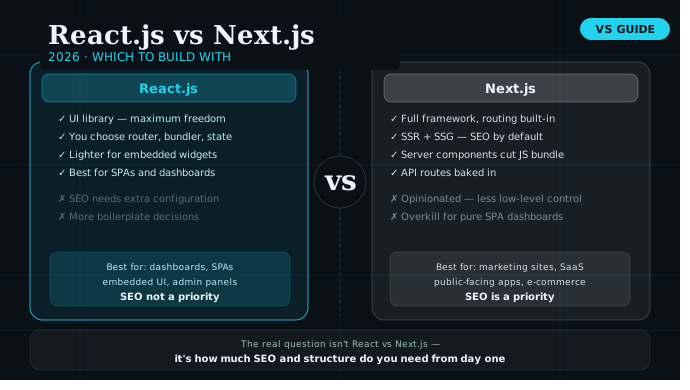
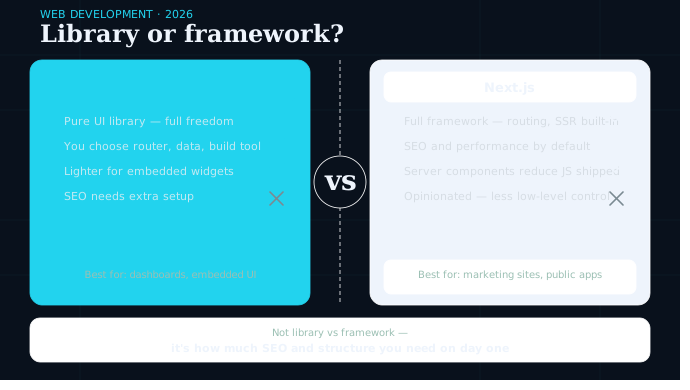
- 1React.js alone is a UI library — you bring routing, SSR, data fetching, and build tooling.
- 2Next.js bundles SSR/SSG, routing, image optimisation and edge runtime — perfect for SEO-critical sites.
- 3Pick React + Vite for internal tools, dashboards, and apps behind auth where SEO doesn't matter.
- 4Pick Next.js (or TanStack Start) for marketing sites, e-commerce, and SaaS where Google traffic is core.
We ship both stacks every week at our React.js development company. The misframing we hear most often: "is React or Next.js better?" They aren't competitors — Next.js is built on React. The real question is whether you need a framework on top of React, and if so, which one.
What React.js actually is in 2026
React 19 is a UI rendering library with Server Components, Actions, and the use() hook. It does not ship a router, a data layer, an SSR pipeline, or a build system. You assemble those yourself — typically TanStack Router, TanStack Query, and Vite. This is exactly what you want for SaaS dashboards, internal tools, admin panels, and React Native apps.
What Next.js adds
Next.js wraps React with file-based routing, server-side rendering, static generation, image optimisation, edge runtime, ISR, and a deeply integrated caching model. The trade-off: more conventions, more magic, and a steeper upgrade treadmill (the App Router rewrote everything once already).
When to pick plain React + Vite
- Auth-walled SaaS dashboards where SEO is irrelevant
- Internal tools and admin consoles
- React Native apps sharing code with web
- Teams that want full control over their stack
Planning a Website? Don't Overpay or Underbuild
Most businesses overspend on features they don't need — or underspend and rebuild within a year. We help you scope it right from day one.
When to pick Next.js (or TanStack Start)
- Marketing sites, blogs, and content platforms
- E-commerce where Google traffic drives revenue
- SaaS with a public marketing surface plus an authed app
- Teams who want batteries-included DX
Performance reality check
Both can hit perfect Core Web Vitals. Next.js gets you there faster out of the box. Plain React + Vite gets you there with more tuning but smaller bundles when you know what you're doing.
The hiring angle
Senior React engineers are plentiful. Senior Next.js App Router engineers are scarcer and command 10–20% higher rates. Factor this into long-term maintenance cost.
Our default in 2026
For new public-facing products we default to TanStack Start (Next.js-style SSR with end-to-end type safety) or Next.js when the team already knows it. For dashboards we use React + Vite + TanStack Router + TanStack Query. contact us if you want a 30-minute opinion on your specific case.
Pro Insight
Planning a cloud-native platform? Let's review your architecture for free.
At ZANISS SOFTWARES, we don't just build websites — we build growth systems.
- ✓SEO-first architecture
- ✓Conversion-focused design
- ✓High-speed performance
- ✓Scalable, future-proof code
📩 Response within 24 hours