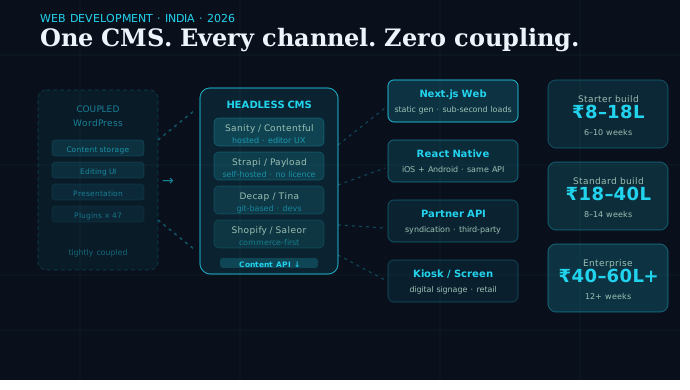
Quick Summary
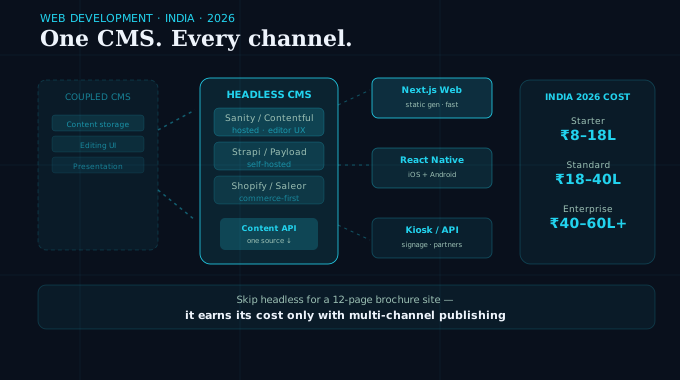
- 1Headless CMS decouples content from presentation — one API powers web, mobile, and kiosks.
- 2Right for multi-channel publishers, e-commerce, and apps with editorial workflows.
- 3Wrong for brochure sites where WordPress would ship in two weeks.
- 4India 2026 build cost: INR 8 L–60 L depending on channels, custom fields, and migration scope.
"Headless CMS" became the default answer to every content question somewhere around 2022. By 2026 we've shipped enough of them — and rebuilt enough WordPress sites that should never have gone headless — to have a clear point of view from our web development practice. Here's the honest framework.
What "headless" actually means
A traditional CMS like WordPress couples content storage, editing, and presentation. A headless CMS separates them: content is stored and edited in one system, then delivered via API to whatever front-end consumes it — a Next.js site, a React Native app, a smart-display kiosk, or all three. The "head" (the presentation layer) is yours to build; the CMS just serves content.
When headless is the right answer
- Multi-channel publishing. One product description that needs to appear on web, mobile app, partner API, and an in-store screen.
- Editorial teams who outgrew WordPress. Custom workflows, role-based publishing, scheduled releases, structured content with strict validation.
- Performance-critical front-ends. Static-generated sites on Next.js, Astro, or TanStack Start that pull content at build time for sub-second loads.
- E-commerce with custom storefronts. Shopify or commercetools at the back, a bespoke React front-end for brand control.
When headless is overkill
If you need a 12-page brochure site with a blog, a hosted WordPress install with a quality theme will ship in two weeks for under INR 2 lakh and an editor who's used WordPress before will be productive on day one. A headless equivalent costs 4–6× more, takes 8–12 weeks, and requires the editor to learn a new tool. Don't pay the headless tax to feel modern.
Indicative headless CMS build cost (India, 2026)
| Build Scope | Price Range | Best For |
|---|---|---|
| Starter — single channel, hosted CMS (Sanity/Contentful) | INR 8–18 L | Marketing sites, blogs, content-led startups |
| Standard — multi-channel, custom schema, editor workflows | INR 18–40 L | E-commerce, media, multi-language brands |
| Enterprise — self-hosted Strapi/Payload, complex roles, migration | INR 40–60 L+ | Publishers, large product catalogues, regulated content |
Planning a Website? Don't Overpay or Underbuild
Most businesses overspend on features they don't need — or underspend and rebuild within a year. We help you scope it right from day one.
The 2026 stack landscape
Four categories of headless CMS cover almost every project we see:
- Hosted, content-first — Sanity, Contentful, Storyblok. Fast to start, predictable pricing, excellent editor UX. Best for marketing teams.
- Self-hosted, open-source — Strapi, Payload, Directus. Full control, no per-seat fees, but you own the ops. Best for product teams with a backend engineer.
- Git-based — Decap CMS, Tina. Content lives in your repo as Markdown. Best for developer-led docs sites.
- Commerce-first — Shopify Headless, commercetools, Saleor. Catalog and checkout built in; you build the storefront.
For most Indian SMB and mid-market builds, Sanity (if budget allows) or Strapi (if self-hosting is fine) covers 80% of cases.
What the build actually costs in India 2026
Pricing varies more than any other category we work in, because "headless CMS project" can mean anything from a 5-page site to a 200,000-product catalogue. The variables: number of content types, number of channels, custom editor features, migration scope, and whether you need multi-language. The pricing table above shows the three bands we see most often. Get those variables wrong in the brief and the quote will be wrong too — see our software audit guide for how to scope properly.
One variable the pricing table doesn't show: WordPress-to-headless migration typically adds ₹3–8L to the project budget depending on content volume, custom field complexity, and the number of URLs needing 301 redirects. Teams that treat migration as an afterthought — something to sort out in the final week — consistently end up delaying launch. Scope it explicitly at brief stage.
The three mistakes that blow up headless projects
- Over-modelling the schema. Teams design 25 content types up front to "future-proof". The editors never use 18 of them; the front-end developers spend weeks wiring up fields nobody fills. Start small.
- Forgetting preview. Editors expect to see drafts before they publish. Headless previews are non-trivial to wire up — budget for them in week one, not week ten.
- Treating migration as an afterthought. Moving 5,000 WordPress posts (with custom fields, media, and SEO redirects) into a clean headless schema is its own sub-project. Underestimate it and the launch slips two months.
Performance and SEO
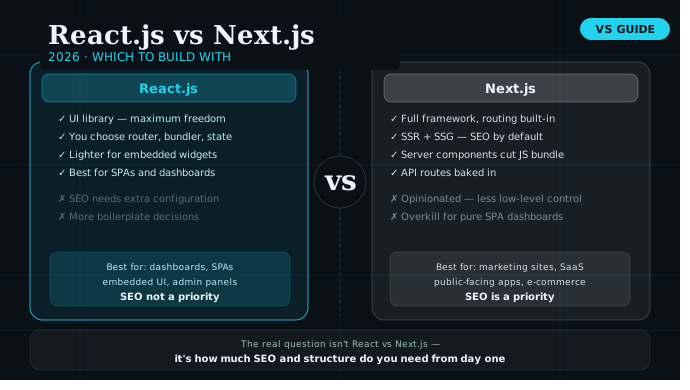
Done well, a headless front-end on Next.js or TanStack Start is faster than 95% of WordPress sites — static generation, image optimization, and edge delivery are standard. Done badly (server-side rendering everything on every request without caching) it's slower than WordPress and three times the hosting bill. The architecture choice matters more than the CMS choice. Pair this guide with our React vs Next.js decision framework when you're picking the front-end.
How we engage
Headless CMS projects start with a one-week content-modelling workshop — we map your existing content, talk to your editors, and produce a schema that survives contact with reality. From there, build is 6–14 weeks depending on scope. contact us when you're ready to scope one.
Pro Insight
Evaluating a headless CMS for your next build? Let's pressure-test the decision.
We've shipped both monolithic and headless CMS projects — we'll tell you honestly which one your use case actually needs.
- ✓Stack selection: Sanity, Strapi, Payload, Contentful
- ✓Content modelling workshop
- ✓Migration plan from WordPress / Drupal
- ✓Editor training included
📩 Response within 24 hours
Frequently Asked Questions
Is a headless CMS more secure than WordPress?
Generally yes, for two reasons. First, the content API is typically read-only and public — there's no admin login URL to brute-force or plugin vulnerability to exploit. Second, there's no monolithic codebase with dozens of plugins, each a potential attack surface. That said, self-hosted headless platforms like Strapi and Payload need the same hardening as any Node.js application — they're not secure by default just because they're "headless."
Can we self-host a headless CMS to save money?
Yes — Strapi, Payload, and Directus are open-source and free to self-host. You'll pay hosting costs (typically ₹3,000–15,000/month) instead of SaaS licence fees. The trade-off is that you own the ops: upgrades, backups, scaling, and security patches. For teams with a backend engineer, it's usually the better long-term choice. For teams without one, a hosted CMS like Sanity or Contentful's free tier often works out cheaper when ops time is factored in.
How long does WordPress-to-headless migration take?
For a typical marketing site (50–200 pages, standard post types), expect 3–5 weeks for content migration alongside the 6–12 week build. For content-heavy sites (1,000+ posts, custom fields, redirect mapping), migration is its own 6–10 week sub-project. The most expensive surprises come from custom WordPress fields that have no clean equivalent in the new schema — map these in week one, not week ten.