Quick Summary
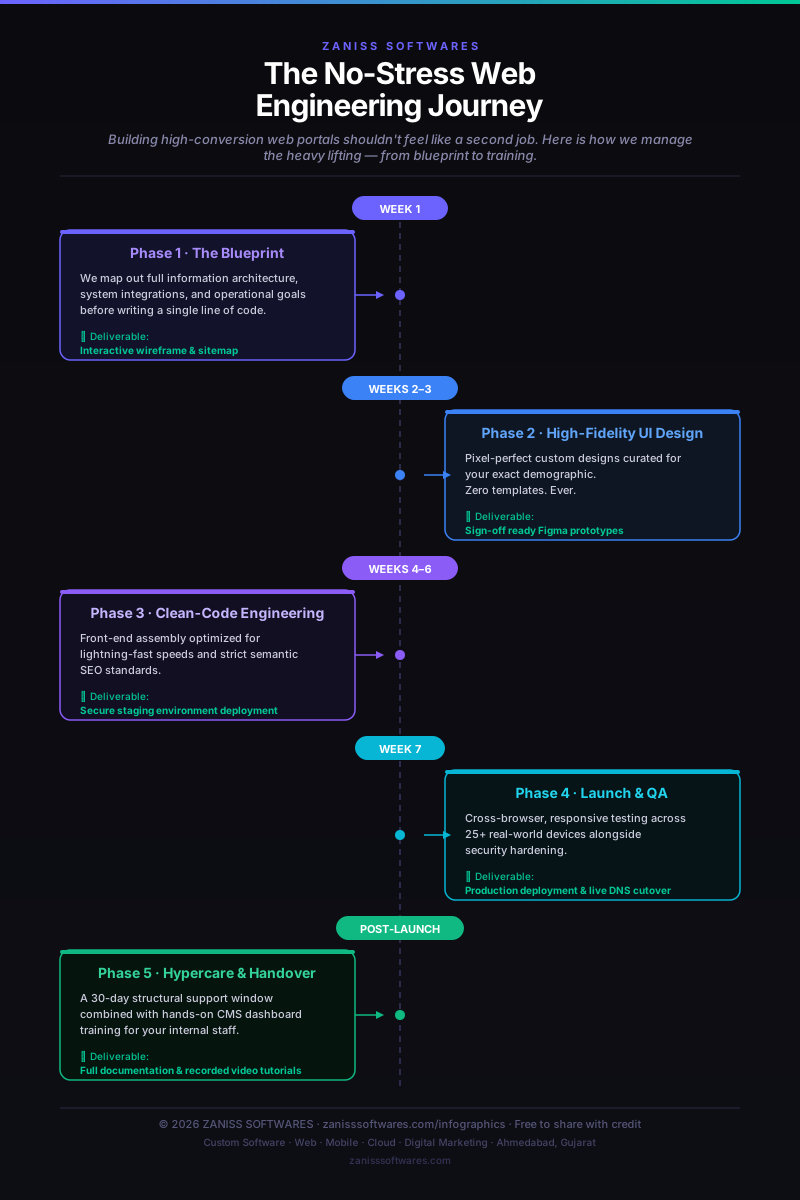
- 1Two-week discovery + signed scope before any wireframe — kills mid-project change orders.
- 2High-fidelity Figma from week three — clients approve the real thing, not greybox wireframes.
- 3Staging URL from day one, weekly walkthroughs — no surprises at the review stage.
- 430-day post-launch warranty — supervised go-live, not a handoff.
Why most web projects feel stressful
The standard web project failure mode isn't technical — it's process. A brief arrives, the team starts building, scope evolves in email threads, deadlines slip, and by launch day nobody is quite sure what was agreed six weeks ago. We've been on both sides of that table, and everything we build now is designed around removing the specific moments where projects break: the handoff between discovery and design, the gap between design approval and build, and the period between development and launch where quality assurance is quietly skipped.
Stage 1 — Discovery and scope definition (Week 1–2)
Before any wireframe or line of code, we spend two weeks making the scope concrete. This means a written requirements document that defines: every page, every feature, every integration, every content dependency, and every third-party system the new site will touch. We also map what we're not building — scope exclusions matter as much as scope inclusions, because they're what prevent mid-project additions from slipping in. The output is a fixed-price quote based on an actual specification, not a conversation.
What this stage produces: a requirements doc, a sitemap, a content checklist, and a signed scope agreement. No wireframes begin until this document is approved.
Stage 2 — Design and prototyping (Week 3–5)
We design in high-fidelity from week three — not low-fidelity wireframes that clients approve then reject when they see colour. High-fidelity prototypes in Figma let you see exactly what you're approving before a single line of code is written. We design mobile-first, because over 70% of Indian web traffic is now mobile. Key screens go through a feedback round before the full design pass begins, so large direction changes happen when they're still cheap.
What this stage produces: approved Figma designs for every page type, a component library, and a responsive mobile design.
Planning a Website? Don't Overpay or Underbuild
Most businesses overspend on features they don't need — or underspend and rebuild within a year. We help you scope it right from day one.
Stage 3 — Development (Week 4–10)
Development begins on the engineering sprint immediately after design approval for the first batch of screens — we don't wait for every screen to be designed before starting to build. We use version-controlled Git repositories with a staging environment that mirrors production exactly. The client has access to the staging URL from day one, so there are no surprises at the review stage. Progress is visible in daily commits and weekly video walkthroughs.
For most projects we use Next.js for the frontend (server-side rendering for SEO, fast load times) with a headless CMS like Sanity or a bespoke backend depending on complexity. We deploy on AWS or Vercel depending on the project's infrastructure requirements. See web development for the full delivery model.
Stage 4 — QA and content population (Week 9–11)
Quality assurance is a dedicated stage, not something squeezed into the final sprint. We test across Chrome, Safari, Firefox, and Edge, on iOS and Android at multiple screen sizes, and run automated accessibility and performance checks (Lighthouse score target: 90+ across all four categories). Content population happens in parallel — the client uploads content to the CMS while QA runs, so launch isn't delayed by copy that arrives late.
What this stage produces: a signed-off QA report, a Lighthouse score, and a fully content-populated staging site ready for the client's final review.
Stage 5 — Launch and 30-day warranty (Week 11–12 and beyond)
Launch day isn't a handoff — it's a supervised go-live. We run a pre-launch checklist covering DNS, SSL, redirects, sitemap submission, and analytics setup, then monitor the live site for 48 hours after launch. Every project includes a 30-day post-launch warranty covering any bugs, layout issues, or performance problems that surface after go-live. After warranty, we offer a retainer for ongoing maintenance, updates, and feature additions.
The one thing that determines whether your project goes smoothly
It's the brief. Projects that arrive with a complete, unambiguous brief — agreed business goals, defined pages, a content plan, and a realistic timeline — consistently deliver on time and on budget. Projects that arrive with "we'll figure it out as we go" consistently don't. We've structured our discovery stage specifically to turn a vague brief into a concrete one before any design begins, because the cost of clarity at week one is tiny compared to the cost of confusion at week eight.
Planning a website build and want a fixed-price quote from a clear scope? contact us for a free consultation.
Pro Insight
Planning a cloud-native platform? Let's review your architecture for free.
At ZANISS SOFTWARES, we don't just build websites — we build growth systems.
- ✓SEO-first architecture
- ✓Conversion-focused design
- ✓High-speed performance
- ✓Scalable, future-proof code
📩 Response within 24 hours
Frequently Asked Questions
How long does a typical website project take end-to-end?
11–12 weeks for a serious marketing or service site with custom design, CMS, and proper QA. Simpler brochure sites can ship in 4–6 weeks; complex web apps run 4–6 months.
Do you give fixed-price quotes?
Yes — but only after the two-week discovery phase produces a written scope. A fixed price against a vague brief is just a number we'll both regret.
What happens after the 30-day warranty?
Most clients move onto a small monthly retainer for updates, security patches, and minor feature work. There's no obligation; you can also self-manage via the CMS we hand over.