Quick Summary
- 1REST is still the default for public APIs; GraphQL wins for variable client needs
- 2gRPC dominates internal service-to-service where latency and contracts matter
- 3API gateway, auth, observability, and docs are 40–55% of total cost
- 4Versioning strategy on day one prevents a year-two breaking-change nightmare
APIs are where most of a 2026 product's value actually lives. Get the contract right and every client — web, mobile, partners, internal — moves faster. Get it wrong and you spend year two rewriting both ends. Here is the decision framework we use.
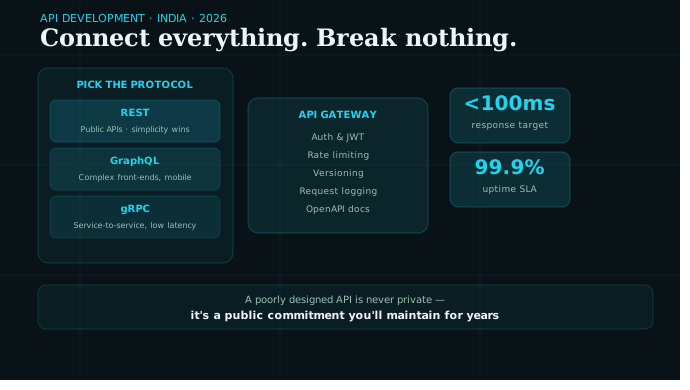
REST, GraphQL, or gRPC — pick by client, not by trend
- REST — default for public APIs. Cacheable, debuggable, every tool understands it.
- GraphQL — best when clients need wildly different slices of the same data (mobile vs admin vs partner).
- gRPC — best for internal service-to-service: strict contracts, low latency, streaming.
Most production estates end up with all three: REST at the edge, GraphQL for one or two client-heavy surfaces, gRPC inside.
The line items that quietly cost more than the endpoints
- API gateway (Kong, Apigee, AWS API GW) — auth, rate limits, quotas, analytics.
- AuthN/Z — OAuth 2.1, mTLS for partners, scopes, key rotation.
- Observability — structured logs, traces, per-endpoint SLOs.
- Developer experience — OpenAPI / GraphQL schema, SDKs, sandbox, changelog.
- Versioning + deprecation policy in writing.
Indicative API build cost (India, 2026)
| Website Type | Price Range | Best For |
|---|---|---|
| Internal REST API (10–20 endpoints) | INR 4–10 L | Single-team product, basic auth, OpenAPI docs |
| Public REST or GraphQL | INR 12–35 L | External developers, gateway, rate limits, SDKs |
| gRPC / event-driven mesh | INR 30 L–1.2 Cr | Microservices at scale, low-latency, multi-team |
Planning a Website? Don't Overpay or Underbuild
Most businesses overspend on features they don't need — or underspend and rebuild within a year. We help you scope it right from day one.
Versioning — the decision you cannot undo cheaply
Pick one path on day one: URI versioning (/v1/...), header versioning, or evolution-only (additive, never breaking). For public APIs, URI versioning is the safest bet. For internal gRPC, evolution-only with proto field reservations works well. Mixing strategies across a single API surface is the most common own-goal.
Security baseline we ship by default
- Per-route auth scopes — least privilege, not "logged in" as a single bit.
- Rate limits and burst protection at the gateway, not in app code.
- Schema validation on every request; reject unknowns.
- Audit log on writes — who, what, when, before / after.
- Key rotation, secret scanning in CI, short-lived tokens.
How we deliver
Every API engagement starts with a contract-first design week — OpenAPI / proto / GraphQL schema reviewed by the actual client teams before a line of handler code ships. It saves 20–35% of build cost on average. See custom software development for the full engineering services or contact us for a contract review of your current spec.
Pro Insight
Planning a cloud-native platform? Let's review your architecture for free.
At ZANISS SOFTWARES, we don't just build websites — we build growth systems.
- ✓SEO-first architecture
- ✓Conversion-focused design
- ✓High-speed performance
- ✓Scalable, future-proof code
📩 Response within 24 hours