In this article
Quick Summary
- 1Functional MVP starts around INR 8 L; production-grade consumer apps run INR 25–80 L
- 2React Native saves 30–40% vs two native codebases for most product categories
- 3Backend, DevOps, and store compliance are 35–50% of total cost — not the UI
- 4Year-two run cost (infra, updates, OS releases) is 18–28% of build cost
Mobile app quotes in India still swing from INR 2 L to INR 2 Cr for ostensibly the same brief. The spread is real and almost always explained by scope honesty, not by who is overcharging. Here is what each tier actually buys in 2026.
What an MVP really includes
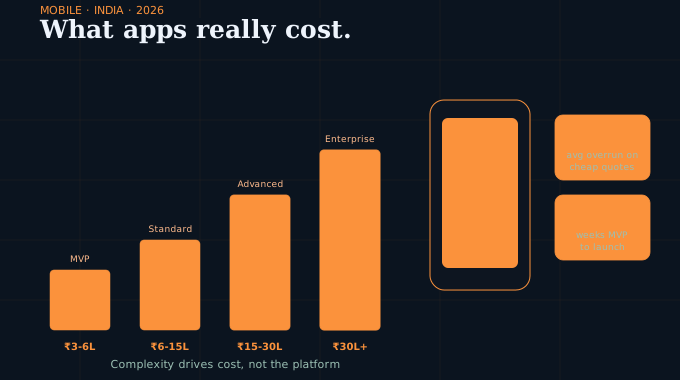
A INR 8–18 L MVP buys roughly 6–10 polished screens, a thin backend, auth, one payment integration, push notifications, basic analytics, and store submission. It does not include offline-first, deep accessibility, a full design system, or sub-second cold start. Those are production-app concerns.
Why production-grade is 3–5x MVP
- Design system, accessibility, and dark mode done right (not retrofitted).
- Crash-free rate above 99.5% — instrumentation, error tracking, release rings.
- Performance budget: cold start, time-to-interactive, frame-rate on midrange devices.
- Offline behaviour, conflict resolution, background sync.
- Security: certificate pinning, secure storage, jailbreak detection where relevant.
Indicative mobile app build cost (India, 2026)
| Website Type | Price Range | Best For |
|---|---|---|
| MVP (1 platform or RN) | INR 8–18 L | Validate the idea, 6–10 core screens, basic backend |
| Production consumer app | INR 25–80 L | Payments, notifications, analytics, polished UX |
| Enterprise / fintech-grade | INR 80 L–3 Cr | Compliance, offline, deep integrations, scale |
Planning a Website? Don't Overpay or Underbuild
Most businesses overspend on features they don't need — or underspend and rebuild within a year. We help you scope it right from day one.
Native vs React Native in 2026
React Native plus the New Architecture has closed most of the gap for content, commerce, fintech UI, and dashboards. Native still wins for camera-heavy AR, complex graphics, and apps that lean hard on platform-specific APIs. Read our deep dive on native vs cross-platform apps before committing.
The line items that hide in cheap quotes
- Backend and APIs — frequently quoted as "included" then descoped.
- DevOps and release pipeline — TestFlight, internal tracks, phased rollout.
- Store compliance — Apple privacy manifests, Play Data Safety, age ratings.
- Localisation — Hindi + 2 regional languages add 4–6% to UI cost.
- Year-one OS support — iOS / Android release cycles need budget, not goodwill.
Run cost after launch
Plan for 18–28% of build cost per year covering infrastructure, OS update support, store policy changes, third-party SDK upgrades, and small UX improvements. Apps that skip this line item are the ones that quietly rot and rebuild every 24 months.
How we scope honestly
We split every mobile engagement into a fixed-price discovery (2–3 weeks, INR 1.5–3 L) and a milestoned build. You get the architecture, design system, and tested estimate before you commit to the build budget. See our mobile app development services or contact us for a candid estimate against your spec.
Pro Insight
Planning a cloud-native platform? Let's review your architecture for free.
At ZANISS SOFTWARES, we don't just build websites — we build growth systems.
- ✓SEO-first architecture
- ✓Conversion-focused design
- ✓High-speed performance
- ✓Scalable, future-proof code
📩 Response within 24 hours
Frequently Asked Questions
Why do app quotes vary so much between vendors?
Mostly because scope, quality bar, and what counts as 'done' are different. A INR 3 L quote almost always assumes a template-grade UI, no real backend, no store compliance work, and no post-launch support. A INR 25 L quote prices the same brief at production quality. Always compare line items, not totals.
Should we build iOS first, Android first, or both together?
In India, Android first usually maximises early reach. For premium / fintech / enterprise audiences, iOS often converts better. With React Native, doing both together adds 15–25% over a single platform — frequently the right call. With native, it almost doubles cost.
How long from kick-off to App Store?
A focused MVP is realistic in 10–14 weeks including store submission. A production-grade consumer app with payments, notifications, and analytics typically takes 5–7 months. Anything faster is usually buying technical debt.