In this article
Quick Summary
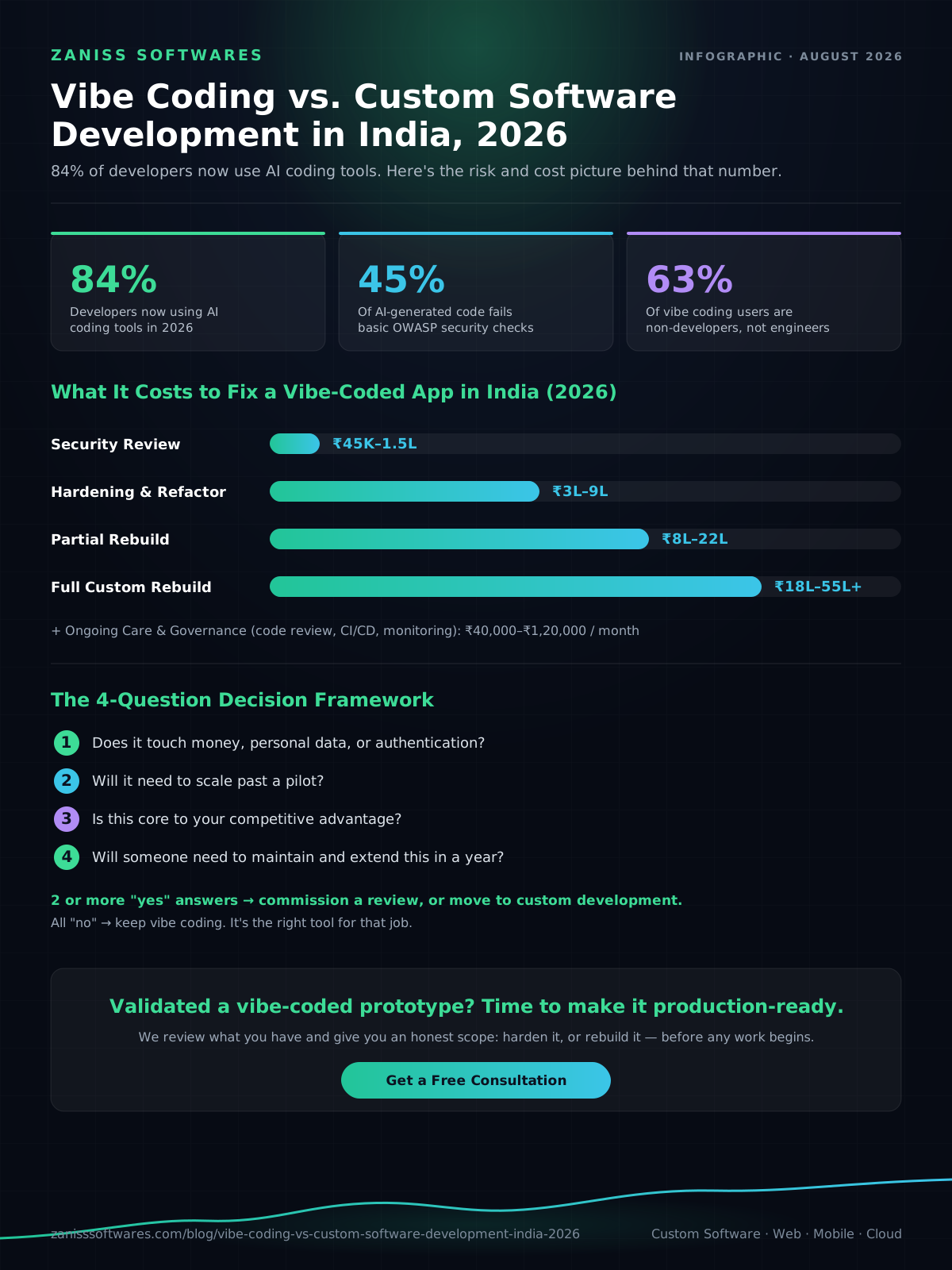
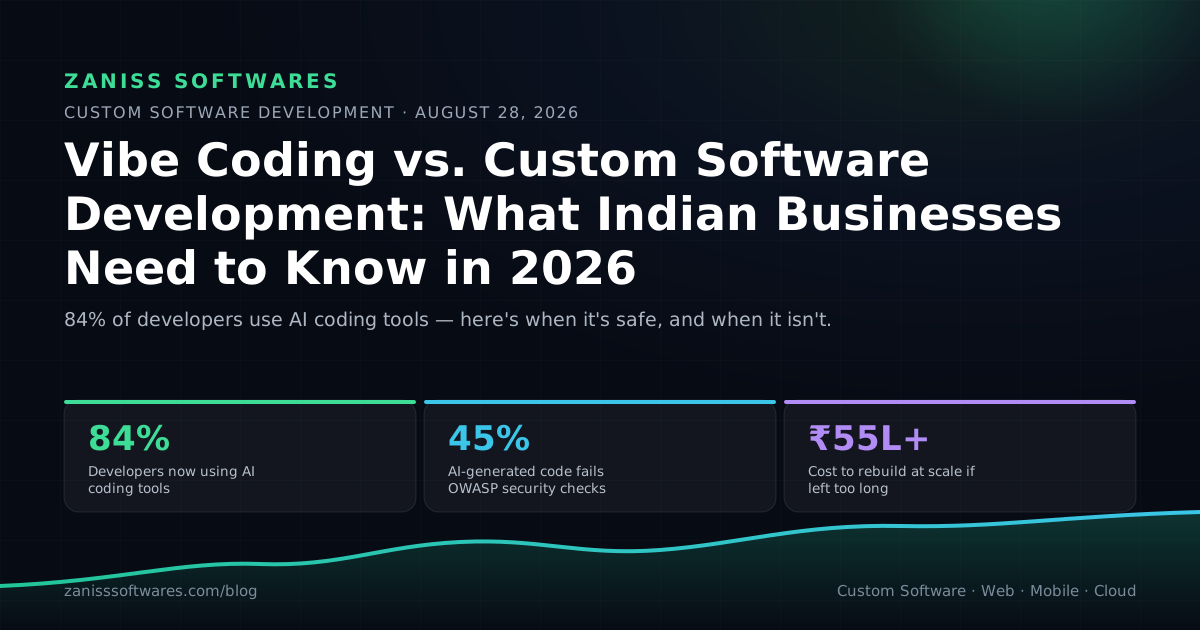
- 1Roughly 84% of developers now use or plan to use AI coding tools, and an estimated 63% of vibe coding users are not professional developers at all.
- 2Independent testing found 45% of AI-generated code samples fail basic OWASP Top-10 checks, with cross-site scripting appearing about 2.74x more often than in human-written code.
- 3Vibe coding is the right call for low-stakes internal tools, prototypes and demand validation — small trusted user base, no sensitive data.
- 4It becomes a liability the moment money, personal data or authentication is involved, especially under India's DPDP Act and investor due diligence.
- 5Fixing a vibe-coded app in India ranges from a ₹45,000 security review to a ₹18,00,000+ full custom rebuild — most businesses land somewhere in between.
Why Every Indian Founder Is Talking About Vibe Coding in 2026
Walk into any startup meetup in Bengaluru, Ahmedabad, or Pune this year and someone will mention shipping a working app “in a weekend” using Lovable, Bolt, or Replit Agent. They're not exaggerating. Vibe coding — describing what you want in plain English and letting an AI model generate the working application — has gone from a novelty to a default starting point for a huge share of new software in India. Adoption data backs up the hallway conversation: roughly 84% of developers now use or plan to use AI coding tools, up sharply from just two years ago, and 90% of developers report using at least one AI tool regularly at work.
For a resource-constrained founder or a marketing head who needs a landing page automated, that's genuinely exciting — especially in a market where experienced engineering talent is expensive to hire and slower to scale than most early-stage budgets allow. The problem is what happens next. A growing number of Indian businesses are discovering that the app which took a weekend to “build” takes months and lakhs of rupees to make production-safe — if it can be salvaged at all. This article lays out where vibe coding is a smart starting point, where it becomes a liability, and the decision framework we use with clients before recommending custom software development.
What Vibe Coding Actually Is (and Isn't)
Vibe coding is prompt-driven application generation: you describe a feature or a whole product in natural language, and a large language model writes, wires up, and often deploys the code. Tools like Lovable, Bolt.new, Replit Agent, and Cursor's agent mode have made this accessible to non-engineers — in fact, an estimated 63% of vibe coding users today are not professional developers at all. That's the appeal: a founder, product manager, or operations lead can go from idea to clickable prototype without waiting on an engineering queue.
What it isn't is a replacement for software engineering discipline. Vibe coding tools optimize for “does this look and behave correctly right now,” not for “will this hold up under real users, real data, and real attackers.” That distinction sounds academic until you look at what's actually shipping.
The Real Numbers: Adoption, Speed, and the Hidden Cost
The productivity story is real but uneven. Large-scale trials show AI-assisted development completing tasks up to 55.8% faster in well-scoped situations, with a 26% increase in completed tasks overall. But the same research shows experienced engineers working on mature, complex codebases were actually about 19% slower with AI assistance, and teams using it heavily reported roughly 41% more bugs surfacing later in the cycle.
The security picture is more sobering, and it's the part Indian businesses tend to underweight. Independent security testing — including Veracode's widely cited GenAI code security research — found that 45% of AI-generated code samples fail basic OWASP Top-10 security checks, with cross-site scripting vulnerabilities appearing roughly 2.74 times more often in AI-generated code than in human-written code. A quarter of one recent Y Combinator startup cohort had codebases that were reportedly 95% AI-generated, and industry trust in AI code has actually fallen even as usage has climbed — from around 77% trust in 2023 to roughly 60% in 2026, with fewer than half of developers consistently reviewing AI output before it ships. Gartner has gone as far as warning that, without proper governance, AI-introduced defect rates could climb as much as 2,500% by 2028. None of this means vibe coding is bad. It means it's a power tool that produces working software and hidden risk in the same motion — and the risk doesn't show up on launch day.
Where Vibe Coding Genuinely Wins for Indian Businesses
We'd be doing clients a disservice if we only talked about the risks, because for a specific set of use cases, vibe coding is the right call and we recommend it ourselves.
It excels at internal tools with a small, trusted user base — a dashboard for the ops team, an inventory tracker for one warehouse, a script that automates a spreadsheet workflow. It's excellent for validating an idea before you've earned the right to spend real engineering budget: a clickable prototype to show investors, a landing page to test demand, a proof-of-concept for a sales pitch. And it's a legitimate way for non-technical founders to get unstuck and start iterating on product thinking instead of waiting weeks for a developer's availability.
The common thread: low stakes if it breaks, small and known user base, and no sensitive data in play. That's a meaningfully different risk profile than a customer-facing product handling payments or personal data.
We've seen this play out well with clients in practice. A logistics operator we work with used a vibe-coded internal tool to replace a shared spreadsheet for tracking vehicle maintenance across two depots — a genuinely good fit, since the “users” were four staff members and the worst-case failure was a missed reminder, not a data breach. That same client, correctly, brought us in when they wanted to expose a version of that tracker to external contractors and tie it to billing.
Planning a Website? Don't Overpay or Underbuild
Most businesses overspend on features they don't need — or underspend and rebuild within a year. We help you scope it right from day one.
Where Vibe Coding Breaks Down — And Why It Matters More in India
The failure mode is predictable and it's already showing up in the market. Reporting this year has tracked thousands of vibe-coded startups now paying professional teams to rebuild what AI tools generated, because the code that worked in the demo couldn't survive real traffic, real edge cases, or a basic penetration test. One widely discussed report put the number of startups now paying to rebuild their AI-generated codebase in the thousands.
For Indian businesses specifically, three things raise the stakes. First, the Digital Personal Data Protection (DPDP) Act imposes real obligations around how personal data is collected, stored, and secured — obligations that a prompt-generated authentication flow with exposed API keys is unlikely to satisfy by accident. Second, Indian startups increasingly raise from investors who now treat AI code governance as a standalone due-diligence line item; Bain & Company's 2026 M&A research found roughly one in five dealmakers walked away from a transaction specifically over anticipated AI-related risk, and unresolved technical or compliance issues have been shown to shave 15–30% off a company's valuation in later-stage diligence. Third, the cost of fixing a security flaw after a breach — in customer trust, in regulatory exposure, in engineering time — is always higher than the cost of building it correctly the first time, and that gap is larger for a smaller company with less room to absorb reputational damage.
The Decision Framework: Vibe Code, Harden, or Build Custom?
Before your next project, ask four questions:
- Does it touch money, personal data, or authentication? If a customer logs in, pays, or shares personal information, treat security as non-negotiable from day one — this pushes toward custom development or, at minimum, professional hardening before launch.
- Will it need to scale past a pilot? If success means 10x the users or transactions within a year, the shortcuts that made a fast prototype possible usually become the exact things that break under load.
- Is this core to your competitive advantage? A workflow that differentiates you from competitors deserves engineering investment; a commodity internal tool generally doesn't.
- Will someone need to maintain and extend this in a year? Vibe-coded applications are frequently difficult for a new developer to read, extend safely, or reason about, because the AI optimized for “working” over “understandable.”
If you answer “yes” to two or more of these, the honest recommendation is to either commission a security and architecture review of what's already built, or move to proper custom software development before you scale further. If you answered “no” across the board, keep vibe coding — it's the right tool for that job.
This is exactly the framework our team walks through on discovery calls, and it's deliberately conservative in one direction: when a client is unsure, we default to recommending a review rather than a rebuild. A review is a small, bounded cost that tells you definitively which path you need. Committing to a rebuild without that information is how businesses end up over-engineering a tool that never needed to leave vibe coding in the first place.
What It Costs to Fix a Vibe-Coded App in India (2026 Pricing)
Costs vary by scope, but these are realistic 2026 ranges we see across Indian engagements, from a lightweight review through a full rebuild.
| Service | Typical Scope | Indicative Cost (INR) | Typical Timeline |
|---|---|---|---|
| Vibe-Coded App Security Review | OWASP Top-10 scan, auth & API key audit, single MVP | ₹45,000 – ₹1,50,000 | 3–7 days |
| Hardening & Refactor (keep AI-built base) | Fix vulnerabilities, add tests, restructure for scale | ₹3,00,000 – ₹9,00,000 | 3–6 weeks |
| Partial Rebuild (core modules only) | Rebuild 30–50% of app — typically auth, payments, data layer | ₹8,00,000 – ₹22,00,000 | 6–10 weeks |
| Full Custom Rebuild | Ground-up rebuild: architecture, scaling, compliance | ₹18,00,000 – ₹55,00,000+ | 10–20 weeks |
| Ongoing Care & Governance | Code review process, CI/CD, monitoring | ₹40,000 – ₹1,20,000 / month | Ongoing |
These figures assume a typical SMB or early-stage SaaS application; regulated industries (fintech, healthtech) and larger data footprints trend toward the upper end of each range.
A Hybrid Playbook: Using Both Without Getting Burned
The best-run teams we work with don't pick a side — they sequence the two approaches deliberately. Use vibe coding to prototype fast and validate that an idea is worth building. The moment real users, real money, or real data enter the picture, bring in a professional review before scaling further — not after an incident forces the issue. Keep vibe coding for genuinely low-stakes internal tools indefinitely; there's no need to “graduate” a spreadsheet-replacement script to custom development just because the company can now afford it. And when a vibe-coded prototype proves the concept, treat the rebuild as a feature, not a failure: you're not throwing away the work, you're carrying the validated idea into an architecture that can actually support your growth targets, your compliance obligations, and the next engineer who has to work on it after you.
Founders sometimes worry that bringing in a development partner at this stage means starting over. In practice, a good rebuild scope reuses everything that's still valid — the product decisions, the UI you already validated with users, the data model where it's sound — and replaces only the parts that can't be trusted at scale, usually authentication, data storage, and anything that touches payments. That's a materially smaller and cheaper engagement than a from-scratch build, and it's the path most of our vibe-coding-to-custom clients actually take.
Companion infographic: Vibe Coding vs. Custom Software Development in India 2026 — The Risk & Cost Breakdown →
Related Articles
- [Custom Software] Software Customization vs Configuration: The ROI & Scalability Decision (India 2026)
- [Business Automation] Custom Software vs Ready-Made Software: Which Is Right for Your Business in 2026?
- [AI] AI Development Cost in 2026: What a Production GenAI App Really Costs
- [Audit] Software Audit Services in India 2026: When, Why, and What It Costs
Working With Us
If you've validated an idea with a vibe-coded prototype and it's time to make it production-ready — or you're planning something that needs to be built right from day one — our custom software development team can review what you have, tell you honestly whether it needs hardening or a rebuild, and give you a fixed scope and timeline before any work begins. Book a free consultation to get that read on your codebase.
Pro Insight
Not sure if your AI-built app is production-ready?
We'll review what you have, flag the security and architecture risks, and tell you honestly whether it needs hardening or a rebuild — with a fixed scope and timeline before any work begins.
- ✓OWASP Top-10 and API key exposure check
- ✓DPDP Act readiness review
- ✓Harden vs rebuild recommendation with INR estimates
📩 Response within 24 hours
Frequently Asked Questions
Is vibe coding safe for building an Indian startup's first product?
It's safe for a prototype used to validate demand or pitch investors, provided you don't put real customer data or payments through it. Before any public launch handling personal data, have it reviewed against OWASP Top-10 risks and DPDP Act obligations — this is typically a few days of work, not a rebuild.
Can we keep our vibe-coded app and just get it audited, or do we need to rebuild it?
Most applications don't need a full rebuild. A security and architecture review will usually tell you whether targeted hardening is enough or whether specific modules — commonly authentication, payments, and data storage — need to be rebuilt on a proper foundation while the rest of the app stays.
How do we know if our Lovable, Bolt, or Replit-built app has security issues?
Common red flags include API keys visible in front-end code, no rate limiting on public endpoints, database rules that allow broad read/write access, and authentication that wasn't explicitly tested for common bypass patterns. A short professional review typically surfaces these within a few days.
What does the DPDP Act mean for AI-generated apps specifically?
The DPDP Act doesn't distinguish between AI-written and human-written code — the obligations around consent, data minimisation, and security safeguards apply regardless of how the software was built. AI-generated code is more likely to have gaps here simply because it wasn't written with compliance requirements as an explicit goal.
How long does it take to convert a vibe-coded MVP into a production-ready custom system?
For a typical SMB application, targeted hardening takes 3–6 weeks; a partial rebuild of core modules runs 6–10 weeks; a full ground-up rebuild is generally 10–20 weeks, depending on scope and integrations.