In this article
Quick Summary
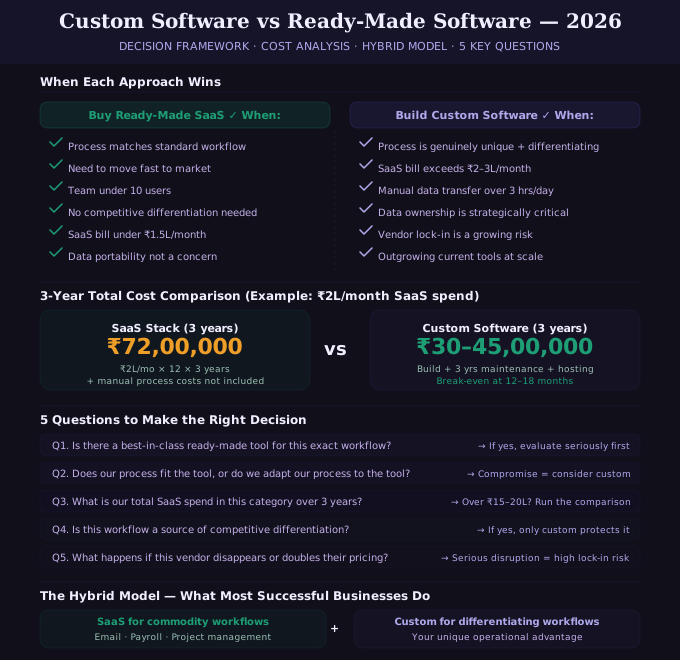
- 1Don't compare monthly SaaS cost to one-time custom cost — compare 3-year total cost of ownership.
- 2100 users × ₹2,000/mo SaaS = ₹72L over 3 years. A ₹20–40L custom build often wins by year 2.
- 3Choose SaaS for standard, commodity processes. Choose custom for workflows that are your competitive edge.
- 4Smart businesses go hybrid — SaaS for HR/email/accounting, custom for core operations.
The build-vs-buy debate sounds like a software question, but it's almost always a business question in disguise. The honest framing isn't "which is cheaper?" — it's "where in our operation does control matter more than convenience, and where is it the other way around?"
Get that mapping wrong and you either burn cash on custom software for problems Zoho already solved, or you spend three years contorting your business to fit a SaaS tool that wasn't built for the way you actually win.
The framing most teams get wrong
The classic mistake is putting "₹2,000/user/month" next to "₹25 lakh one-time" and concluding SaaS is cheaper. That comparison ignores headcount growth, integration cost, switching cost, and the value of owning your data. The right comparison is 3-year total cost of ownership, weighted by how strategic the workflow is to your business.
The two models, plainly
SaaS — renting a building someone else designed
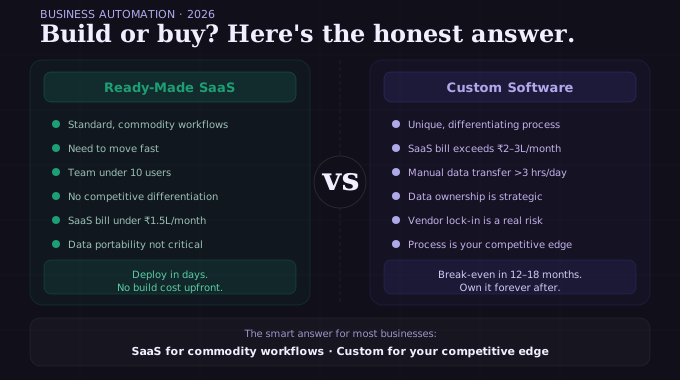
You pay monthly, you get updates and uptime, and you accept the floor plan. Great fit for processes that look the same in every business: payroll, email marketing, accounting, video calls. The price is that any time your workflow drifts from the SaaS team's roadmap, you have to either bend your process to fit or wire together three other tools to fill the gap.
Trade-offs that bite later: per-seat pricing scales linearly with headcount, exporting your data is rarely as easy as importing it was, and a vendor pivot or shutdown can leave you with 90 days to migrate critical operations. Anyone who lived through Stripe Atlas changes or a sudden Google Workspace pricing reset knows this isn't theoretical.
Custom — building on your own land
Higher upfront capex, longer time-to-first-value (typically 3–6 months for an MVP), and you own the code, the database, the deployment pipeline, and every business rule baked in. The right choice when the workflow is the business — not a generic supporting function.
Trade-offs people underestimate: you also own the maintenance burden, the on-call rotation, and the upgrade path. A well-architected custom software development project bakes those costs in from day one; a poorly architected one becomes the next thing you're rewriting.
The 3-year math, with realistic numbers
Consider a 100-person operations team using a stack of three SaaS tools at a blended ₹2,000/user/month:
- Year 1: ₹24 lakh in subscriptions + ~₹3 lakh in integration tooling and admin time
- Year 2: ₹26–28 lakh (typical 8–15% renewal increases plus headcount drift)
- Year 3: ₹30 lakh+ — and you still don't own the data
- 3-year total: ~₹80 lakh, with linear cost growth as the team grows
A focused custom build covering the same workflows usually lands in the ₹25–45 lakh range over 9–12 months, plus 18–22% annual maintenance. The break-even is typically year two for teams above 60 active users, and the curve diverges sharply after that.
The math flips the other way for small teams. At 8 users on the same stack, SaaS costs ₹19,200/month — building custom would take 10+ years to pay back, and that's before counting opportunity cost. SaaS wins clearly there.
When SaaS is genuinely the right answer
- The workflow is commodity — payroll, helpdesk tickets, email marketing, video conferencing.
- You need it running this week, not this quarter.
- The team using it is small enough that per-seat pricing stays manageable.
- The vendor has a track record (5+ years, profitable, real support) — not a pre-Series-A startup that might pivot in 18 months.
Planning a Website? Don't Overpay or Underbuild
Most businesses overspend on features they don't need — or underspend and rebuild within a year. We help you scope it right from day one.
When custom earns its cost
Your workflow is the moat
If a competitor could replicate your operation by buying the same SaaS subscriptions you use, you don't have a workflow advantage. Custom is justified precisely when the way you handle a customer or fulfil an order is the thing customers pay for.
You're already paying SaaS twice
The classic signal: you have a CRM, an order tool, and a billing tool — and three full-time people whose job is moving data between them in spreadsheets. That manual integration cost is invisible in the budget but very real on the P&L. We've seen ops teams reclaim 15–30% of capacity by replacing the spreadsheet bridge with one purpose-built system.
Compliance or data residency is non-negotiable
Healthcare PHI, RBI-regulated financial data, government contracts, or any industry where "where exactly does this data live?" has a legal answer — SaaS makes that conversation harder than it needs to be. Custom on your own cloud account, with documented controls, is the cleaner audit story.
You've outgrown the SaaS tier you're on
What worked at ₹2 crore revenue often breaks at ₹20 crore. The signal is usually a sudden ₹40 lakh enterprise quote from your previous ₹15,000/month vendor — at which point custom is on the table whether you wanted it or not.
The hybrid pattern that almost always wins
The mature answer for mid-market businesses isn't "SaaS or custom" — it's both, intentionally. Use SaaS for the commodity layers (Google Workspace for email, Razorpay for payments, Zoho Books for accounting, Slack for comms). Build custom for the operational core where your edge lives. The boundary between the two is the API contract.
The architecture move that makes this work: a thin custom orchestration layer that owns your customer data and integrates with the SaaS tools via webhooks. Now you can swap any SaaS tool without rewiring your business, and your IP stays inside the layer you own.
The five-question decision framework
- Is this workflow a competitive advantage, or a cost centre?
- What does the 3-year total cost look like, including integration and admin time?
- What's the cost — in money and downtime — of switching SaaS vendors in year three?
- Where does the data legally need to live, and who needs to audit it?
- If the SaaS vendor disappeared in 90 days, what would we do?
If the answers to two or more of those favour control, custom usually wins on a 3-year horizon. If they all favour speed and convenience, stay on SaaS and revisit in 18 months.
What businesses actually feel after the right call
- Operational margin improves because manual integration disappears.
- Headcount can grow without subscription costs growing in lockstep.
- The data warehouse becomes useful instead of fragmented across vendor exports.
- Vendor risk stops being a quarterly board topic.
Related reading
For the partner-selection side of this decision, read how to choose a software development company. For budgeting context: the India website cost guide.
Not sure whether to build or buy?
We don't push custom by default — half our build-vs-buy reviews end with "stay on Zoho, fix the integration." If you'd like a candid look at your current stack and the 3-year cost picture, contact us or explore our custom software development approach.
Pro Insight
Planning a cloud-native platform? Let's review your architecture for free.
At ZANISS SOFTWARES, we don't just build websites — we build growth systems.
- ✓SEO-first architecture
- ✓Conversion-focused design
- ✓High-speed performance
- ✓Scalable, future-proof code
📩 Response within 24 hours
Frequently Asked Questions
Is custom software better than SaaS?
Custom software is better for unique workflows and scalability, while SaaS is ideal for standard processes.
Is custom software expensive?
It has a higher upfront cost but is often more cost-effective over the long term compared to SaaS subscriptions.