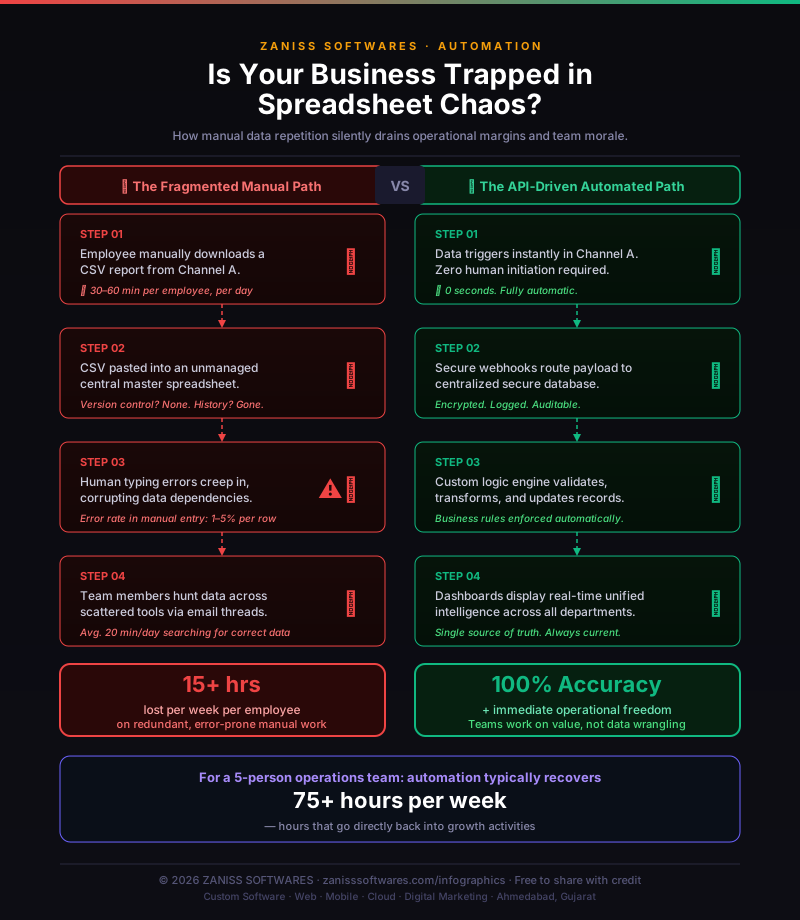
Quick Summary
- 1Shadow spreadsheets are integration gaps — and they cost ₹5–20L per year in recoverable labour at scaling SMBs.
- 2Custom API integrations typically pay back in 4 months and save 8L+ annually thereafter.
- 3iPaaS tools (Zapier, Make) are right for simple, low-volume flows between popular SaaS apps.
- 4Custom is right when APIs are complex, volume is high, or the integration is business-critical.
The spreadsheet beside the system is the symptom
Every growing business eventually develops what we call "shadow spreadsheets" — Excel or Google Sheets documents that live beside the official software system because the official system doesn't quite do what the team needs. Sales orders exported from the CRM and re-entered into the accounting software. Inventory levels maintained manually because the warehouse system doesn't talk to the e-commerce store. Customer data copied from email into a support ticket tracker.
Each of these spreadsheets is a symptom of an integration gap. And each one carries a cost that most businesses have never formally calculated: the labour hours spent on manual data work, the errors introduced in manual entry, the delays caused when data is out of sync, and the decisions made on stale information. When we audit operational workflows for clients before a custom software development engagement, we consistently find that 8–15% of staff time at scaling SMBs is spent on work that could be eliminated by API integration.
Planning a Website? Don't Overpay or Underbuild
Most businesses overspend on features they don't need — or underspend and rebuild within a year. We help you scope it right from day one.
Calculating your actual cost of spreadsheet chaos
The formula is simple: (staff hours per week on manual data tasks) × (hourly cost) × 52 = annual cost of the problem.
A team of five people each spending 3 hours per week on data entry and export/import tasks at ₹400/hour average cost = ₹15,600/week = ₹8.1L per year. That's the minimum — it doesn't count the cost of errors, the cost of delayed decisions, or the cost of customer-facing mistakes caused by data that was one copy-paste behind.
Most clients who go through this exercise discover the problem is costing them ₹5–20L per year in recoverable labour cost alone, before error cost is factored in.
When API automation makes economic sense
API automation (connecting two software systems so data flows automatically without human intervention) typically costs ₹1–5L to build for a standard integration between two modern systems with documented APIs. The business case is simple: if the spreadsheet work costs ₹8L per year and the integration costs ₹3L to build, you recover the build cost in about 4 months, then save ₹8L every year after.
The economics improve further when you factor in that API integrations scale infinitely — they process the same volume of data whether you're a team of five or fifty, at the same cost. The spreadsheet approach grows linearly with headcount.
When to build custom vs use an iPaaS tool
iPaaS tools (Zapier, Make, n8n) are the right starting point for simple, low-volume integrations between popular SaaS tools. If you're connecting Mailchimp to a spreadsheet, or sending Typeform responses to Slack, an iPaaS tool is faster and cheaper than custom code.
Custom API integration is the right answer when: the systems involved have complex or undocumented APIs, the data volume is high enough to make per-task iPaaS pricing expensive, the business logic around the integration is non-trivial (conditional routing, error handling, audit logs), or the integration is business-critical enough that a managed service going down is unacceptable. We scope and build both ends through custom software development and IT consulting.
Tired of your team copy-pasting between systems? contact us for a free consultation.
Pro Insight
Planning a cloud-native platform? Let's review your architecture for free.
At ZANISS SOFTWARES, we don't just build websites — we build growth systems.
- ✓SEO-first architecture
- ✓Conversion-focused design
- ✓High-speed performance
- ✓Scalable, future-proof code
📩 Response within 24 hours
Frequently Asked Questions
How long does a typical API integration take to build?
Two to six weeks for a standard integration between two well-documented modern systems. Older or undocumented systems can push that to 8–12 weeks because most of the work is reverse-engineering the data model.
Will the integration break when one of the systems updates?
Sometimes. Well-built integrations include version pinning, error alerting, and a maintenance retainer to address breaking changes. Budget 10–15% of build cost per year for ongoing care.
Can we start with Zapier and migrate to custom later?
Yes — that's often the right path. Zapier validates the workflow at low cost; once volume or complexity outgrows it, the workflow is well-understood and the custom build is faster and cheaper.