In this article
Quick Summary
- 1The expensive part of picking wrong isn't the invoice — it's losing 6–9 months and starting over with someone else.
- 2How a vendor handles discovery, communication, and ownership predicts project success far more reliably than their portfolio or quote.
- 3Always insist on owning the source code, cloud accounts, and database in writing — before kickoff, not at handover.
- 4Talk to two reference clients on the phone. Ask what went wrong, not what went well — that's where the truth lives.
- 5Use the 10-factor evaluation framework and the 15-question contract checklist in this guide before signing anything.
Choosing the wrong software development company is one of the most expensive mistakes a business can make in 2026. We have spent the last decade picking up rebuilds from agencies that delivered late, freelancers who disappeared mid-project, and offshore teams that produced code nobody else could maintain. The pattern is always the same: the selection process was rushed, the wrong signals were trusted, and the real cost only showed up six to twelve months later.
This guide is the framework we genuinely use when a client asks us to second-opinion a shortlist of vendors. It covers the ten factors that actually predict success, the fifteen questions you must get answered in writing before signing a contract, the local-vs-remote trade-off, and the red flags that should immediately disqualify a vendor — no matter how polished their pitch deck looks.
Why Choosing the Right Development Partner Matters
A software project is rarely a one-off purchase. It is a multi-year relationship with the team that controls the code your business runs on. Pick the wrong partner and you inherit a slow-motion crisis: budget overruns, missed launch dates, security vulnerabilities, vendor lock-in, and a codebase so tangled that the only realistic path forward is a complete rewrite.
Industry research consistently shows that more than two-thirds of software projects either fail outright or significantly exceed their original budget and timeline. In our own intake calls, roughly 40% of inbound enquiries are businesses asking us to take over a project that another vendor abandoned, mismanaged, or built so poorly that maintenance has become impossible. The original quote — the number that often drove the selection — is almost never what the project actually cost.
The downstream costs of picking wrong include lost market windows (a six-month delay can hand a category to a faster competitor), team morale damage (internal stakeholders disengage from projects they no longer believe in), and the very real risk of a data breach if the vendor cut corners on security. The right custom software development partner protects all of that. The wrong one quietly destroys it.
10 Factors to Evaluate Before Hiring a Software Development Company
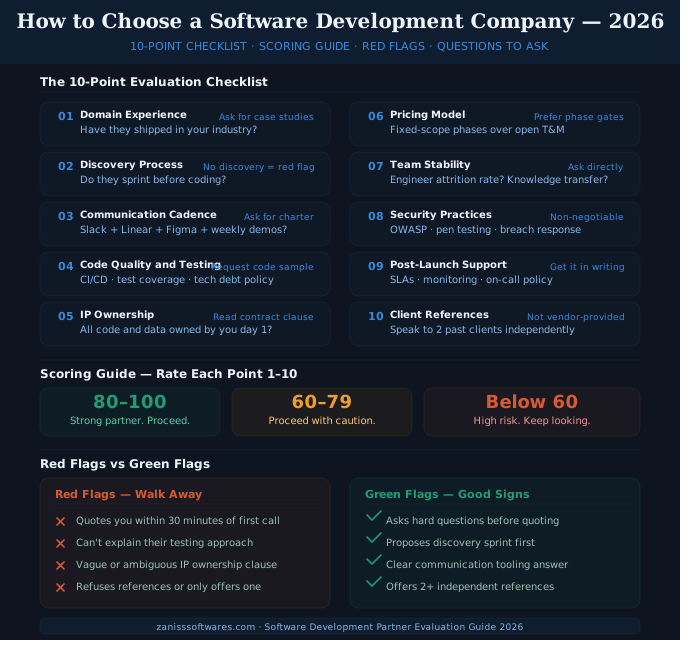
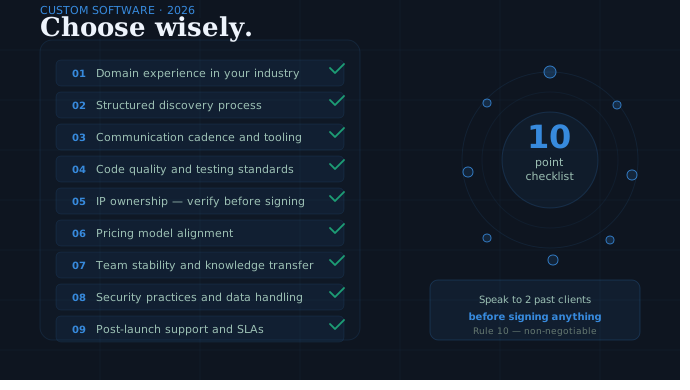
Use these ten factors as your primary scoring rubric. Score each vendor from 1–5 and weight industry experience, security practices, and code ownership the highest. Anything below a 3 on those three is a hard disqualifier.
1. Industry Experience
Fintech projects fail without RBI, PCI-DSS, or PSD2 awareness. Healthcare needs HIPAA-grade PHI handling. Logistics needs offline-first thinking. Domain familiarity is not optional — it shows up in the questions a vendor asks in week one and the bugs you do not hit in month four. Ask for case studies in your specific vertical, not generic "we have built apps" claims.
2. Technical Expertise
Look beyond the buzzword list. Ask which version of React, Node, or .NET they last shipped to production, whether they have run Kubernetes at scale, and how they choose between SQL and NoSQL for a new module. Strong technical teams will give you specific, opinionated answers. Weak ones will say "we work with everything."
3. Discovery Process
A serious partner runs a paid 1–2 week discovery sprint before quoting a fixed price. Deliverables should include stakeholder interviews, workflow mapping, a risk register, prioritised scope, and a budget range with confidence levels. If you receive a fixed quote and timeline after a single 30-minute call, you are being sold optimism — and the first change request will arrive within weeks.
4. Communication
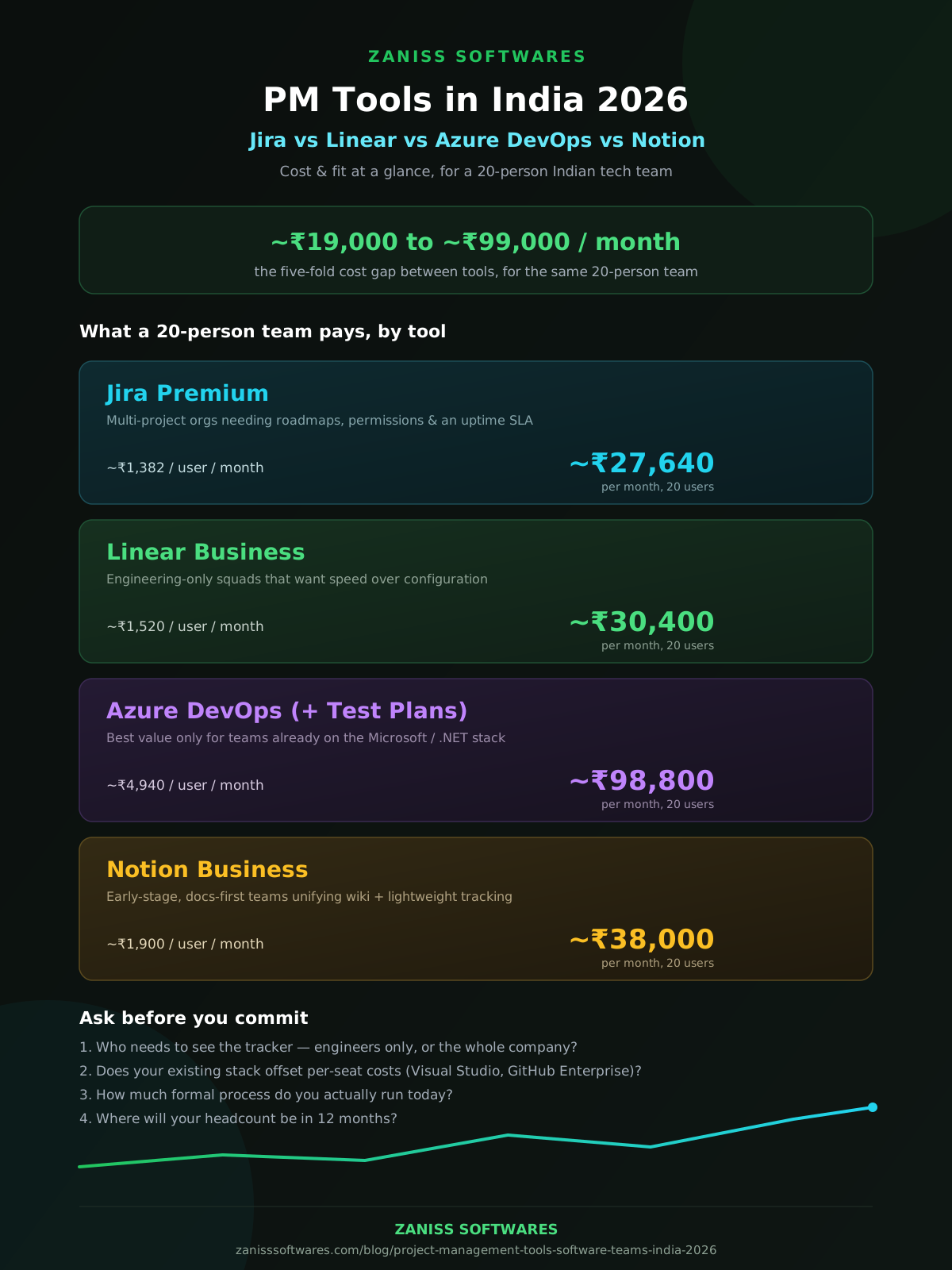
Ask specifically: who runs the daily standup, who you can WhatsApp on a Sunday if production is down, what tooling they use (Linear, Jira, Notion), and what the weekly demo cadence looks like. "Our PM will keep you posted" translates to "you will find out about delays at the demo."
5. Security Practices
You are looking for specifics: secrets in a vault rather than .env files in git, least-privilege IAM roles, encrypted backups with tested restore drills, dependency scanning in CI, and a documented incident-response runbook. If they wave a "we follow best practices" answer, they don't. Our cloud solutions write-up covers the baseline we set up on day one of every engagement.
6. Code Ownership
This must be in the contract before kickoff, not "we will figure it out at handover." You should own the GitHub or GitLab organisation, the AWS, GCP, or Azure root account, the domain, the database, the CI/CD secrets, and every third-party service signed up using your email. We have seen vendors hold deployment access hostage during payment disputes. Handle this on day zero.
7. Project Methodology
Pure waterfall rarely survives contact with real users. Pure Scrum without product discipline produces velocity theatre. The methodology that works for most mid-sized projects is dual-track agile: a discovery track defining the next 4–6 weeks of scope, and a delivery track shipping 2-week sprints with a working demo every Friday.
8. Post-Launch Support
The first 90 days after launch are when 80% of real-world bugs surface. Confirm in writing what support tier you get post-launch — SLA response times, included hours per month, and the escalation path for production incidents. A vendor who treats post-launch as a separate sales conversation does not believe in their own build quality.
9. Client References
Do not accept written testimonials. Insist on a 20-minute phone call with two past clients whose projects shipped at least 12 months ago. Ask: "What did the team get wrong? What would you do differently? Did the people you started with finish the project?" The answers will be more candid than anything on a case study page.
10. Pricing Transparency
Be wary of vendors who refuse to share blended hourly rates or a clear change-request pricing matrix. The most reliable pricing model for mid-sized projects is fixed-cost per milestone, a documented change-request process, and a small 10–15% time-and-materials buffer for edge cases nobody can scope upfront.
Agency vs Development Company vs Freelancer
This is one of the most common questions in early procurement, and the answer depends heavily on your project's size, timeline, and ongoing support needs.
Freelancer
Solo or small team, project-based
BEST FOR SMALL PROJECTS
- ✓Lower hourly cost
- ✓High flexibility
- ✓Direct communication
- ✗Single point of failure
- ✗Limited capacity to scale
- ✗No structured process
- ✗Post-launch risk
Software Dev Company
Dedicated team, full lifecycle
BEST FOR SERIOUS PRODUCTS
- ✓Full team: devs, QA, PM
- ✓Structured delivery process
- ✓Scalable capacity
- ✓Long-term partnership
- ✓Post-launch support SLAs
- ~Higher cost (but predictable)
Digital Agency
Broad services, marketing-led
BEST FOR BRAND + WEB
- ✓Design + dev under one roof
- ✓Strong UI/UX focus
- ✓Brand consistency
- ✗Weaker on complex logic
- ✗May subcontract dev work
- ✗Not built for enterprise
The "near me" question
Local doesn't automatically mean better. Many excellent software companies operate fully remote with clients across multiple time zones. What matters is communication overlap, not geography. That said, for regulated industries like healthcare or finance, local legal jurisdiction can matter for contracts and compliance.
Use a freelancer when the scope is small, well-defined, and short-term — a marketing landing page, a Shopify theme tweak, a one-off integration script.
Use an agency when you need a design-heavy campaign site, a branded mobile app for a launch, or a 2–3 month engagement with clear deliverables.
Use a software development company when you are building a multi-year product, operating in a regulated industry, or need a partner who will still be around to support the system three years from now. This is the right call for SaaS platforms, internal enterprise tools, and any system your business genuinely depends on.
15 Questions You Must Ask Before Signing Anything
These 15 questions will reveal more about a potential partner than any proposal document ever will. Use them in your final evaluation calls.
10 Red Flags That Reveal an Unreliable Firm
Due diligence isn't just about what a firm has — it's about what they don't say, don't ask, and don't show. These are the warning signs that experienced technology buyers have learned to watch for.
Extremely low pricing that undercuts the market
A quote 40–60% below market average isn't a deal — it's a different product. Expect junior teams, no testing, no documentation, and a vendor that disappears at the first real obstacle.
They send a quote before understanding your requirements
Any firm that quotes a price in the first conversation is either guessing or using a template. Neither is a good start to a multi-month engagement.
No verifiable client references
A Clutch.co profile with generic reviews isn't a reference. Ask for two clients you can actually call. "We can't share due to NDA" is acceptable once — never for every client.
They agree with everything you say
A good partner will push back on bad ideas. "Yes, we can build that" to every request means they're not thinking critically about your problem — or they will be the moment the invoice is signed.
Vague or non-existent contract terms
If the contract doesn't clearly define deliverables, timelines, IP ownership, and exit clauses — walk away. Ambiguity always benefits the vendor, never the client.
High staff turnover or subcontracting without disclosure
Ask directly: "Will the team that pitches us be the team that builds our product?" Bait-and-switch staffing is rampant in this industry.
No security or compliance conversation
If you're in healthcare, finance, or handling user data, a partner that doesn't proactively raise security isn't ready for your project. Vague answers on OWASP, ISO 27001, or SOC 2 should disqualify.
Unrealistic timelines and "we can ship anything fast"
"We will ship your full platform in six weeks" is either a lie or a guarantee of a rewrite within a year. Serious teams pad estimates and explain trade-offs.
Poor communication during the sales process
If they take three days to reply when they're trying to win your business, what will month six look like? Pre-sale responsiveness is the best predictor of in-flight communication.
No documentation or testing deliverables
Without architecture diagrams, API docs, ops runbooks, and a documented test process, your next vendor will spend three months reverse-engineering the system at your expense.
Planning a Website? Don't Overpay or Underbuild
Most businesses overspend on features they don't need — or underspend and rebuild within a year. We help you scope it right from day one.
Local Software Development Company vs Remote Development Partner
The "software development company near me vs remote partner" question comes up in almost every selection process. The honest answer in 2026 is that the local-versus-remote axis matters less than it did five years ago, but the trade-offs are still real.
Benefits of a Local Partner
- In-person workshops for discovery, design reviews, and stakeholder alignment.
- Familiarity with local regulations, payment rails, and language preferences.
- Easier procurement, contracting, and invoicing under your local tax regime.
- On-site integration support when your system has to interface with physical hardware or legacy on-premise systems.
Benefits of a Remote Partner
- Access to a much larger talent pool, including specialised expertise that may not exist locally.
- Better pricing — often 30–60% lower for equivalent seniority.
- Mature async communication and documentation culture, which usually produces better long-term maintainability.
- Follow-the-sun coverage when you need 24/7 support across multiple time zones.
Our recommendation: a hybrid model. Use a remote core engineering team for the bulk of delivery, paired with quarterly on-site visits for major planning sessions and an annual in-person retrospective. This captures most of the cost advantage of remote while preserving the relationship intimacy that drives long projects to a good finish.
How to Verify a Development Team's Technical Skills
Polished pitch decks are not evidence. Use this technical due-diligence checklist before committing:
- GitHub or GitLab repositories. Public repos reveal code style, commit hygiene, and engineering culture. No public code at all is a yellow flag for senior claims.
- Case studies with named systems. "Built a logistics platform" is marketing. "Built order routing for X company, handling 50K shipments/day" is evidence.
- Certifications. AWS Solutions Architect, Google Professional Cloud, ISO 27001, SOC 2 Type II. Easy to verify, hard to fake.
- Reference calls focused on technical leadership. Ask past clients: "Did their senior engineer make architectural decisions you still agree with two years later?"
- Architecture review session. Ask them to walk you through the system diagram of a recent project. Good engineers do this confidently; bait-and-switch agencies cannot.
- Code quality standards. Linting, formatting, PR templates, code review checklists — ask to see them.
- Security practices. Dependency scanning, secret rotation policy, incident-response playbook. These should exist in writing.
Cost vs Quality: Finding the Right Balance
Most buyers frame this as "expensive vs cheap." That framing usually leads to a bad decision. The useful frame is total cost of ownership over the next 36 months.
Low-Cost Providers
Pros: Low cash outlay. Fast to onboard. Acceptable for genuinely small, short-lived projects.
Cons: Junior teams, no architecture review, minimal testing, no documentation. The hidden cost is the rebuild you will pay for in year two — usually 2–3× the original budget.
Mid-Market Providers
Pros: Reasonable balance of cost, quality, and process maturity. Most legitimate custom software development engagements live here. Good fit for companies with budgets between ₹15 lakh and ₹1 crore (US$20K–120K).
Cons: Quality varies widely within this tier — selection rigor matters more here than anywhere else.
Premium Providers
Pros: Senior teams, deep specialisation, strong process, predictable delivery. The right choice for regulated industries, mission-critical systems, and projects with material business risk.
Cons: 2–4× the mid-market rate. Overkill for simple internal tools or short campaigns.
The Cost vs Value matrix that actually works: plot vendors on quoted price (X-axis) against expected total cost of ownership over 36 months (Y-axis). The cheapest bid almost never wins on that second axis. The best vendors typically sit in the upper-middle of the price band but in the lowest band of three-year TCO.
Final Thoughts
The best software development company is rarely the cheapest. It is the partner that:
- Understands your business well enough to push back on bad ideas.
- Has proven experience shipping in your domain, with named systems and contactable references.
- Provides transparent pricing, written ownership terms, and a documented change-request process.
- Runs a strong discovery process before quoting a fixed price.
- Offers ongoing support with a real SLA, not a "we'll figure it out" handshake.
Picking well takes 3–6 weeks. Picking badly costs 12–24 months. The math is overwhelmingly in favour of slowing down at this stage.
Related reading
Pair this guide with our India website cost guide for budget benchmarks, the custom vs ready-made framework if you are still deciding whether to build at all, and the discovery sprint guide for what a good vendor's first two weeks should look like.
For businesses based in Gujarat, we have also published a local guide covering the top software development companies in Ahmedabad and what to evaluate when hiring locally.
How we work at ZANISS SOFTWARES
Every engagement at ZANISS SOFTWARES starts with a paid 1-week discovery sprint, a written scope with prioritised cuts, named senior engineers committed to the project end-to-end, and full code and infrastructure ownership transferred to you from day one. Whether you need custom software development, cloud solutions, mobile app development, or IT consulting, the process is the same: understand the business, scope it honestly, ship in 2-week increments, and support the system long after launch.
If you want a second opinion on a quote you have already received, contact us — we can usually spot the rough edges in a 30-minute call.
Pro Insight
Planning a cloud-native platform? Let's review your architecture for free.
At ZANISS SOFTWARES, we don't just build websites — we build growth systems.
- ✓SEO-first architecture
- ✓Conversion-focused design
- ✓High-speed performance
- ✓Scalable, future-proof code
📩 Response within 24 hours
Frequently Asked Questions
How do I choose a software development company?
Evaluate them on discovery process, domain experience, communication discipline, security practices, code ownership terms, pricing transparency, and reference calls — not just the quoted price. Insist on a paid discovery sprint before signing a fixed-scope contract.
What should I ask before hiring software developers?
Ask who owns the source code and cloud accounts, who specifically will be on your team, how change requests are priced, what testing and security practices are followed, and whether you can speak to two past clients on the phone.
How much does custom software development cost in 2026?
Focused MVPs typically start at ₹6–12 lakh (US$8K–15K). Mid-market platforms land between ₹25–60 lakh (US$30K–75K). Enterprise systems can exceed ₹1 crore. Anyone quoting under ₹3 lakh for 'custom software' is almost always selling a template.
Should I choose a local or remote software development company?
Local partners help when face-to-face workshops, regulatory familiarity, or on-site integration matter. Remote partners give you a wider talent pool, specialised expertise, and better pricing. Most modern projects work well with a remote core team plus quarterly on-site visits.
How do I verify a development team's technical expertise?
Review their public GitHub repos, request architecture diagrams from past projects, ask for case studies in your domain, check certifications (AWS, ISO 27001, SOC 2), and run a paid technical audit or a small trial sprint before committing to a long contract.
Software development company vs freelancer — which is better?
Freelancers are cheapest and fastest for narrow, well-scoped tasks. Agencies suit short campaigns and design-heavy work. A software development company is the right call for multi-year products, regulated industries, and anything where continuity, security, and post-launch support matter.
What are the biggest red flags when hiring a software development company?
Unusually low pricing, no discovery process, refusal to share past client references, vague code-ownership terms, unrealistic timelines, no written testing process, no documentation deliverables, and a senior team in the sales call who disappears after the contract is signed.
How long does it take to choose the right software development partner?
Plan for 3–6 weeks: 1 week to shortlist, 1–2 weeks for discovery calls and proposals, 1 week for reference checks and contract review, and 1 week of buffer. Rushing this stage is the single most common reason projects fail later.
What is a discovery sprint and why does it matter?
A discovery sprint is a paid 1–2 week engagement where the vendor maps stakeholders, workflows, risks, and prioritised scope before quoting a fixed price. It is the cheapest insurance you can buy on a software project and the strongest predictor of on-time delivery.
Who should own the source code after the project ends?
You should — always. The contract must transfer 100% ownership of source code, the cloud root account, the database, the domain, the CI/CD secrets, and every third-party service signed up using your email. Get this in writing before the first invoice.