In this article
Quick Summary
- 1Offshore success is 80% operating model, 20% vendor choice — even great vendors fail with bad engagement structure.
- 2Run two-week sprints with one synchronous 30-minute weekly call. The rest goes async over written updates.
- 3Lock IP, repo, and credential ownership in the MSA before any code is written.
- 4Insist on a paid 1–2 week discovery sprint before signing any fixed-price build commitment.
Hiring an offshore software development company in India is a well-trodden path — and a well-littered one. The vendors that ship and the vendors that fail look identical on a sales call. The difference shows up in month two, when the demo slips, the senior lead "got reassigned," or the bill arrives with line items you never agreed to.
This guide is the engagement playbook we use with our overseas clients. It applies whether you're hiring out of Ahmedabad, Bangalore, or Pune.
Why offshore to India in 2026
- Cost arbitrage holds. Senior Indian rates run 40–60% below US/UK rates without sacrificing quality at the top end of the market.
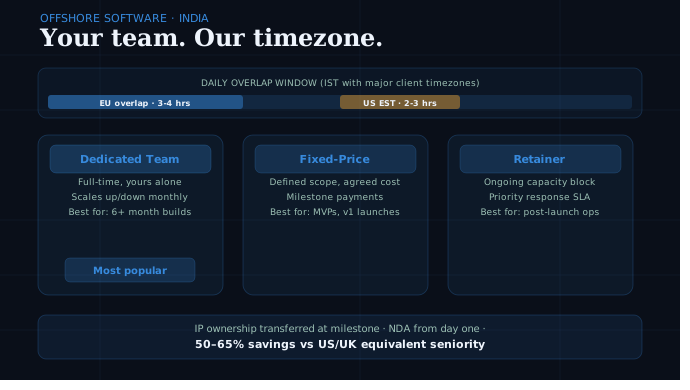
- Time-zone coverage. India overlaps with EMEA daytime, US evenings, and APAC mornings — daily handoff with any region is workable.
- Mature outsourcing ecosystem. Two decades of global product work means contract templates, communication norms, and PM tooling are well established.
For pricing detail, see our companion piece on custom software development in India.
Contract structure — get this right before code starts
- Master Services Agreement (MSA) with IP assignment. Work-for-hire clause, explicit assignment of all IP to your entity, NDA covering subcontractors. Non-negotiable.
- Statement of Work (SoW) per sprint or phase. Scope, acceptance criteria, named team members, change-request process, and a fixed per-hour change rate.
- Milestone-based payment, not upfront. 20–30% on signing, the rest tied to demoable milestones. Walk away from 90%-upfront asks.
- Ownership of repo, cloud, registrar, and third-party accounts in your name. Repo on your GitHub org. Cloud bill on your card. No exceptions.
- Termination-for-convenience clause with a defined notice window (usually 30 days) and a clean handover checklist.
The operating cadence that actually works
- One synchronous weekly call. 30 minutes. Demo, risks, decisions. That's it.
- Async daily standups. Written, in Slack or Linear. 4 lines: did, doing, blockers, decisions needed.
- Every sprint ends with a working demo + Loom walkthrough. No "we're 80% done." Either it demos or it doesn't.
- Weekly written status email. One page. What shipped, what slipped, what changed, what's next.
If your offshore vendor pushes for more sync calls than this, you have a delivery confidence problem to surface — not a cadence to accept.
Planning a Website? Don't Overpay or Underbuild
Most businesses overspend on features they don't need — or underspend and rebuild within a year. We help you scope it right from day one.
Risk controls overseas buyers consistently underweight
- Security baseline. Mandate MFA on every account, secrets in a vault (not in .env files in Slack), and a documented credential-rotation policy. We expand on this in our cloud solutions write-up.
- Knowledge concentration. If one engineer holds 80% of the system in their head, you have a single point of failure. Require pair-programming or rotating PR review.
- Attrition exposure. Ask for the vendor's 12-month attrition rate. Above 25% means your project lead may not be there in month four.
- Subcontracting. Some Indian agencies subcontract silently. The MSA should require written disclosure of any subcontractor with code access.
Discovery first, then build
The single biggest predictor of offshore failure is jumping to a fixed-price build before a real discovery phase. A paid 1–2 week discovery sprint produces workflow maps, architecture sketch, risk register, and a phased budget with confidence ranges — and gives both sides an honest exit ramp if it turns out the fit isn't right.
Choosing the vendor — short checklist
- Meet the named senior engineer before signing — by name, on video.
- Three live reference calls in your industry, not testimonials.
- Paid discovery as standard, not optional.
- Written IP, repo, and credential ownership in your name from day zero.
- Milestone-based payment, <30% upfront.
- Attrition rate disclosed.
- Security practices documented, not described verbally.
For a longer evaluation framework, see how to choose a software development company and the city-specific Ahmedabad guide.
How ZANISS SOFTWARES runs offshore engagements
We're a senior boutique Ahmedabad team running async-default engagements with clients in the UAE, the UK, the US, and Australia. One weekly sync, written daily standups, working demo every sprint, full handover of source and infrastructure. Our IT consulting line also covers fractional-CTO support for overseas founders who need engineering oversight without a full in-house hire. If your offshore build also needs a launch website, our trusted web development company in Ahmedabad can ship the marketing site in parallel. Browse representative work in our portfolio.
Where to start
If you're scoping an offshore engagement, the cheapest first step is a 30-minute call to pressure-test the project. We'll tell you honestly whether offshore is the right answer, what realistic budget and timeline look like, and what controls your contract should include. contact us when you're ready.
Pro Insight
Planning a cloud-native platform? Let's review your architecture for free.
At ZANISS SOFTWARES, we don't just build websites — we build growth systems.
- ✓SEO-first architecture
- ✓Conversion-focused design
- ✓High-speed performance
- ✓Scalable, future-proof code
📩 Response within 24 hours
Frequently Asked Questions
What is an offshore software development company?
A software firm in a different country to yours that delivers product engineering work — typically chosen for cost arbitrage, time-zone coverage, or access to a talent pool not available locally. India is the largest offshore destination globally.
How do I protect IP when working with an offshore vendor?
Sign an MSA with explicit work-for-hire and IP assignment clauses before any code is written, host the repo on your own GitHub/GitLab organization, own all cloud accounts, and include an NDA covering all subcontractors. Reputable Indian vendors will accept this without pushback.
How often should I sync with an offshore team?
One 30-minute synchronous call per week is usually enough. Everything else — sprint plans, demos, blockers, retros — runs async over Loom videos, written updates, and shared dashboards. More than two sync calls a week usually signals a communication problem to fix, not a cadence to maintain.