Quick Summary
- 1Lift-and-shift: INR 12–40 L per major workload; re-platform 2–4x that
- 2Year-one cloud bill usually lands 15–25% higher than the on-prem TCO it replaced
- 3Data egress, observability, and DR are the most under-budgeted line items
- 4Re-platform pays back inside 18–24 months when right-sized; lift-and-shift rarely does
Most "we'll just move to the cloud" projects miss budget by 40–60%. The reason is almost never the compute bill — it is the line items nobody priced in the original deck. Here is a 2026-honest breakdown of what a real migration costs in India and where the surprises hide.
The three migration patterns and what they actually cost
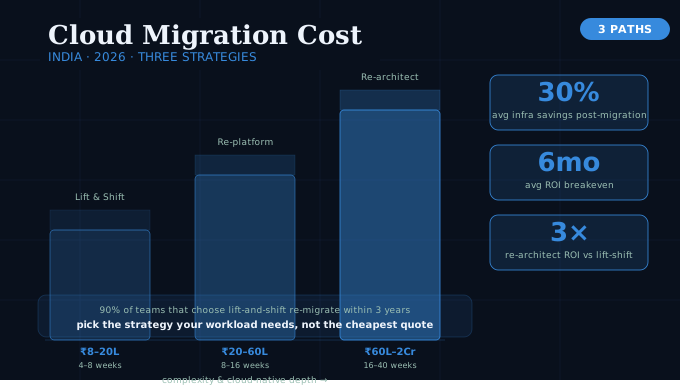
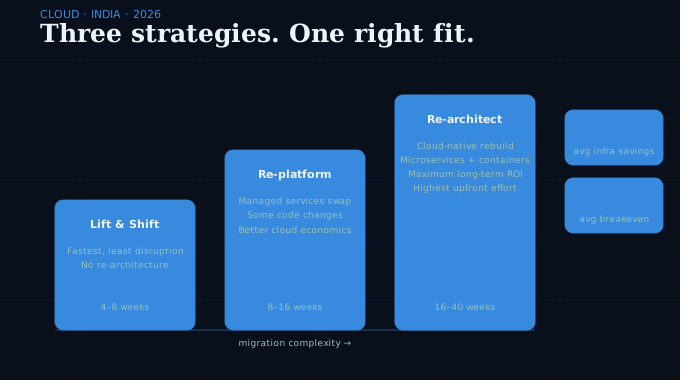
- Lift-and-shift: rehost VMs as-is. Fast (8–16 weeks per major workload), INR 12–40 L per app. Cloud bill rarely beats on-prem TCO.
- Re-platform: containers, managed databases, managed message brokers. 4–9 months, INR 30 L–1.5 Cr. Real savings start here.
- Refactor: rebuild around serverless / event-driven. 9–18 months, INR 1–4 Cr. Reserve for strategic apps only.
Indicative cloud migration cost (India, 2026)
| Website Type | Price Range | Best For |
|---|---|---|
| Lift-and-shift (per workload) | INR 12–40 L | Speed-to-cloud, low-change apps, regulatory deadlines |
| Re-platform (containers + managed DB) | INR 30 L–1.5 Cr | Real cost savings, scale, modern ops |
| Refactor to cloud-native | INR 1–4 Cr | Strategic apps, multi-region, serverless / event-driven |
Planning a Website? Don't Overpay or Underbuild
Most businesses overspend on features they don't need — or underspend and rebuild within a year. We help you scope it right from day one.
Where the surprise bills land
- Data egress — moving data out of the cloud costs real money; multi-region designs amplify it.
- Observability — Datadog / New Relic / Grafana Cloud bills often rival the compute bill on chatty workloads.
- Disaster recovery — a real DR posture (RPO < 15 min, RTO < 1 hr) typically adds 25–40% to steady-state cost.
- NAT, load balancer, and KMS — small per-unit costs that compound on busy clusters.
- Reserved capacity true-ups — savings plans that did not match actual usage.
Why year-one usually costs more
Almost every migration runs on-prem and cloud in parallel for 3–6 months, books one-time data transfer fees, and over-provisions cloud until the team learns the workload's real shape. A 15–25% year-one overshoot vs prior TCO is normal — and not a sign the migration was a mistake.
How to actually save money in year two
- Right-size aggressively at month 4 once real telemetry is in.
- Move stable baseline to 1- or 3-year savings plans / reserved instances.
- Tier storage — hot, warm, cold — with lifecycle policies.
- Cut idle non-prod environments on a schedule; rebuild on demand.
- Refactor the top 2–3 bill-driver services to managed equivalents.
For a deeper dive on ongoing cost control, read cutting cloud bills without breaking production. See cloud solutions for migration services or contact us for a fixed-fee discovery against your current estate.
Pro Insight
Planning a cloud-native platform? Let's review your architecture for free.
At ZANISS SOFTWARES, we don't just build websites — we build growth systems.
- ✓SEO-first architecture
- ✓Conversion-focused design
- ✓High-speed performance
- ✓Scalable, future-proof code
📩 Response within 24 hours