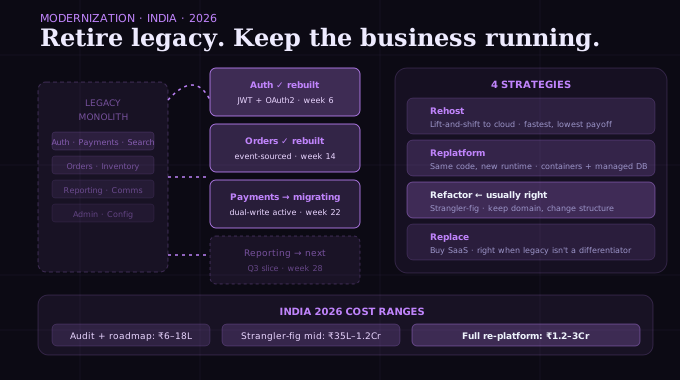
Quick Summary
- 1Big-bang rewrites fail 60–70% of the time — the strangler-fig pattern is the safer default.
- 2Modernization cost in India 2026: INR 25 L–3 Cr depending on scope, data, and integrations.
- 3The first 90 days should be audit + seams, not new code.
- 4Database and auth are the hardest seams — plan them before the UI rewrite.
Why most modernization projects stall
Legacy modernization rarely fails for technical reasons. It fails because the team commits to a big-bang rewrite, the business cannot freeze for 18 months, and the new system never reaches parity with the old one. The teams who succeed treat modernization as an incremental engineering programme — not a project with a launch date — and they protect revenue every week of the journey.
The four strategy choices
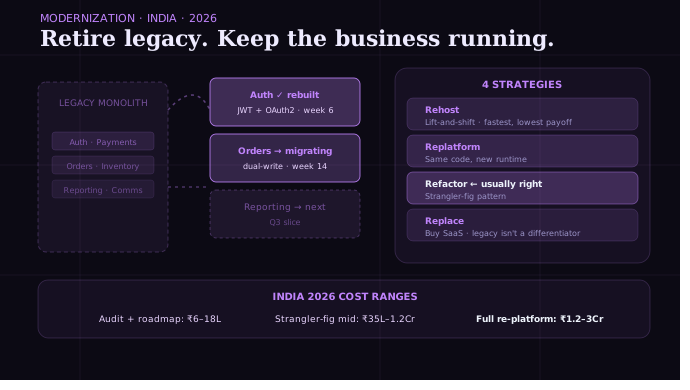
- Rehost — lift-and-shift to cloud. Fast, low risk, modest payoff. Useful as a step, rarely the destination.
- Replatform — same code, new runtime (containers, managed DB). Buys reliability and ops wins without rewriting logic.
- Refactor / re-architect — keep the domain, change the structure. The strangler-fig path, usually the right answer.
- Replace — buy a SaaS product, retire the legacy. Right when the legacy isn't a differentiator.
Most real programmes blend two or three of these. Our software audit is the place this decision actually gets made — with numbers, not opinions.
The Indian legacy landscape in 2026
The most common legacy systems we modernize for Indian clients fall into a recognizable set: Tally-integrated custom ERP modules built in VB.NET or older ASP.NET WebForms, on-premise Oracle or SQL Server applications running on physical servers in office server rooms, desktop applications that were never designed for concurrent remote access, and PHP 5-era web applications whose original developers are no longer available. Each has its own modernization pattern — the Tally integration question alone shapes whether a migration can be phased or needs a clean cut. If your system fits one of these archetypes, mention it when you reach out; our audit checklist has specific sections for each.
The strangler-fig playbook
Named after a tree that grows around its host until the host can be removed, the strangler-fig pattern wraps the legacy system in a new façade (typically an API gateway or BFF) and migrates capabilities one slice at a time. Each slice ships to production behind a feature flag; traffic shifts gradually; the old code is deleted only after the new code has carried real load. Risk stays bounded and the business never freezes.
- Weeks 1–6 — Seams. Identify cut points: auth, payments, search, reporting. Stand up the façade, route 100% of traffic through it unchanged.
- Weeks 6–14 — First slice. Pick a low-risk, high-visibility module (often read-only reporting or a single workflow). Rebuild on the target stack. Dual-write or shadow-read until parity is proven.
- Weeks 14–40 — Repeat. One module per sprint or two. Keep deployment frequency on the new stack at least weekly.
- Final phase — Decommission. Turn off legacy modules once traffic and data have moved. Archive the database, document the retirement.
Indicative legacy modernization cost (India, 2026)
| Modernization Scope | Price Range | Best For |
|---|---|---|
| Audit + modernization roadmap | INR 6–18 L | Codebase, data, integrations, ranked plan |
| Strangler-fig migration (mid-size app) | INR 35 L–1.2 Cr | Incremental rewrite over 6–12 months |
| Full platform re-platforming | INR 1.2–3 Cr | Multi-module ERP / core systems, 12–24 months |
Planning a Website? Don't Overpay or Underbuild
Most businesses overspend on features they don't need — or underspend and rebuild within a year. We help you scope it right from day one.
The hardest seams: data and auth
UI rewrites are the easy part. The two seams that decide whether modernization succeeds are the database (because shared schemas couple everything) and authentication (because users won't tolerate a re-login storm). Plan both before the first sprint: pick whether you'll dual-write, change-data-capture, or do a one-shot cutover per table, and decide whether the new auth will federate with the legacy session or replace it. Get these wrong and every other slice gets harder.
Where the budget actually goes
- ~25% — discovery, audit, and the migration plan itself.
- ~35% — the façade, data plumbing, and dual-run infrastructure.
- ~30% — rebuilding the actual business logic, slice by slice.
- ~10% — cutover, decommission, documentation, and handover.
Teams that underestimate the middle 35% are the same teams that go over budget. The plumbing is where the real engineering lives.
When a big-bang rewrite is actually right
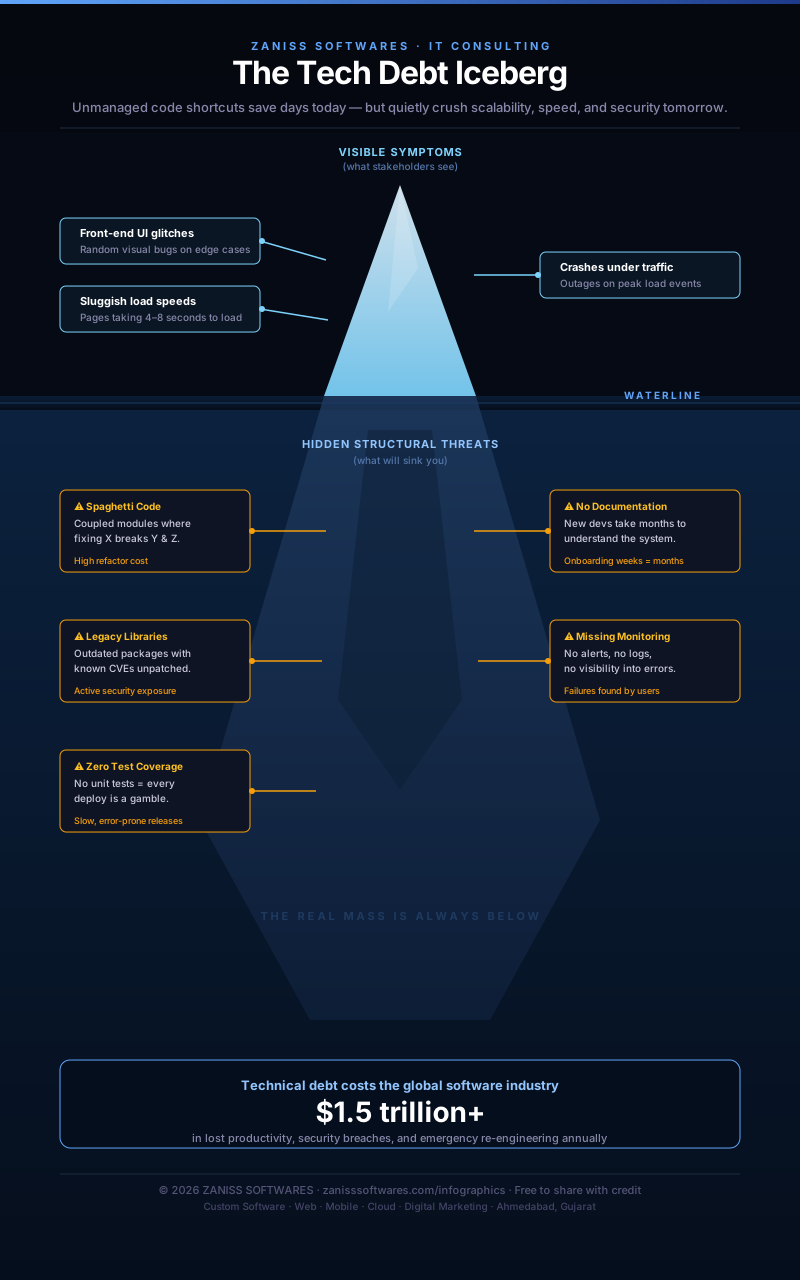
Rarely — but sometimes. If the legacy stack is genuinely unmaintainable (the original vendor is gone, no source, no tests, no one understands the data model) and the system is small enough to rebuild in under six months, a clean rewrite can be the honest answer. Above that scale, the strangler-fig almost always wins. Our take on tech debt and hidden risk covers how to tell which situation you're in.
How we engage
Modernization programmes start with a 3–4 week audit (codebase, data model, integrations, infra) and produce a ranked, costed roadmap. Delivery runs in fixed-scope quarterly slices with a steering review at each boundary — no 18-month commitment up front. See IT consulting or contact us for a scoped modernization assessment.
Pro Insight
Sitting on a legacy system that's slowing you down? Let's map a modernization path.
At ZANISS SOFTWARES, we don't just rewrite code — we de-risk the journey off your legacy stack.
- ✓Strangler-fig migration playbook
- ✓Data & auth seam planning
- ✓Quarterly fixed-scope delivery
- ✓No 18-month commitment up front
📩 Response within 24 hours
Frequently Asked Questions
How long does a typical modernization programme take?
For a mid-size application (5–15 modules, 5–10 years old), expect 9–18 months for a full strangler-fig migration. Smaller systems with fewer integrations can complete in 6–9 months. The audit and roadmap phase at the start takes 3–4 weeks regardless of system size — don't skip it to save time, because it's what keeps the rest on track.
Do we have to migrate to the cloud as part of modernization?
No — cloud migration and modernization are separate decisions that often happen together but don't have to. Many modernization programmes replatform to containers or microservices while staying on-premises, then move to cloud as a separate phase once the architecture is cleaner. The two-in-one approach is faster on paper but riskier in practice.
What's the single biggest mistake in legacy modernization?
Starting with the UI. The interface is the most visible part but the easiest to rebuild — what kills modernization projects is underestimating the database coupling and the authentication seams. Teams that redesign screens first run out of budget and momentum before they've touched the hard parts. Start with the seams, not the surface.