Infographic 18 · ZANISS SOFTWARES

Enterprise Software Risk Mitigation Matrix

The most expensive place to discover a risk is in production. The second most expensive is during active engineering. The cheapest place — by a factor of 10 to 100 — is in discovery, before any code is committed. This page maps every known risk to a defined quadrant response, and shows how a 2-week discovery sprint clears each one in order.

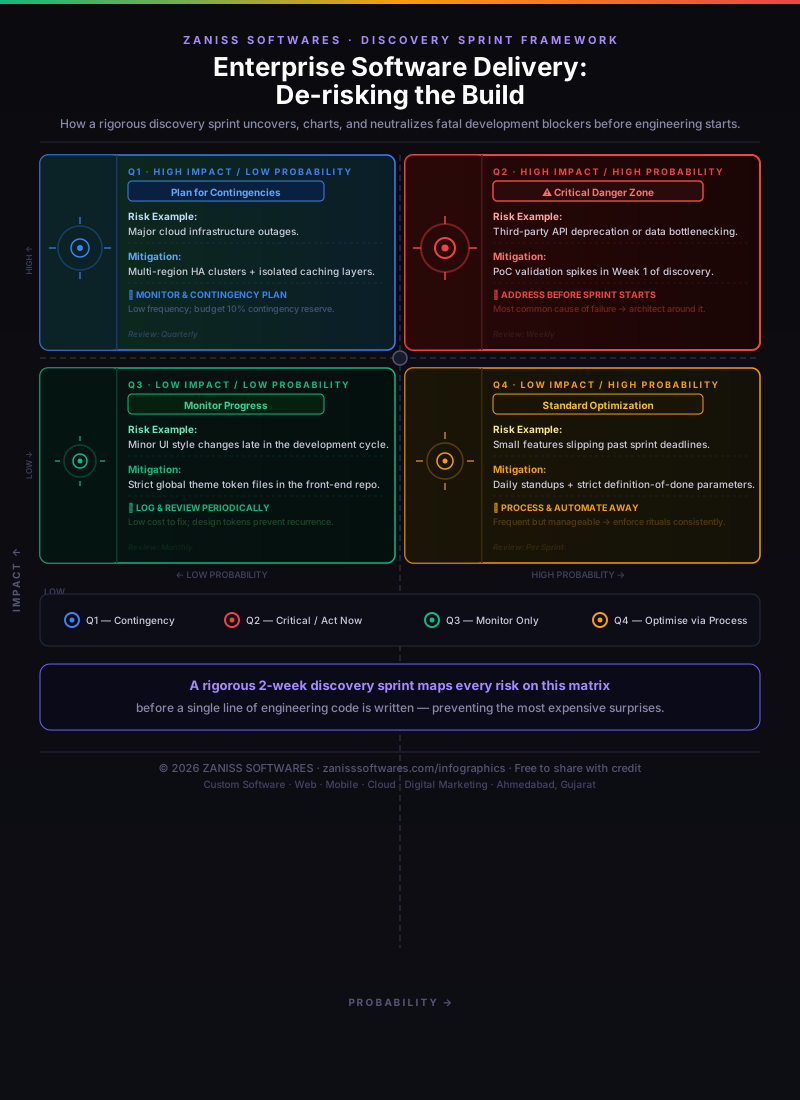
Enterprise Software Risk Mitigation Matrix — infographic by ZANISS SOFTWARES
Enterprise Software Risk Mitigation Matrix · Source: ZANISS SOFTWARES — free to share with credit and a link back to this page.

Key takeaways

  • Q1 (High impact / Low probability) → Plan for contingencies: multi-region HA clusters, 10% budget reserve, quarterly review
  • Q2 (High impact / High probability) → Critical danger zone: address before sprint starts via Week 1 PoC validation spikes
  • Q3 (Low impact / Low probability) → Monitor progress: log and review monthly; global theme token systems prevent the most common variant
  • Q4 (Low impact / High probability) → Standard optimisation: daily standups and strict definition-of-done parameters
  • A rigorous 2-week discovery sprint maps every known risk onto this matrix before a single line of engineering code is written

Why Risk Mapping Belongs in Discovery, Not Retrospectives

The 2×2 matrix gives every identified risk a home in one of four quadrants, each with a defined response strategy. The act of populating the matrix forces the team to surface assumptions, validate third-party dependencies and challenge architectural decisions before they are load-bearing. Most software project post-mortems identify risks that were knowable in week one of the project. The retrospective question is almost always the same: 'why didn't we check that before we built on top of it?' The discovery risk matrix is the answer — it makes the checking systematic, documented and contractually prior to the first sprint.
The Four Quadrant Strategies in Practice

Q1 — high impact, low probability — are rare but catastrophic. Major cloud infrastructure outages sit here. The response is not to solve them upfront but to design for recovery: multi-region high-availability architecture, isolated caching layers and a 10% contingency budget reserve. Q2 — high impact, high probability — is the danger zone. Third-party API deprecation, data bottlenecks at scale and wrong integration assumptions sit here. These must be addressed in Week 1 of discovery through proof-of-concept validation spikes. Q3 — low impact, low probability — are minor risks logged and reviewed monthly; a global theme token system eliminates the most common variant. Q4 — low impact, high probability — are things that will definitely happen but will not sink the project: small features slipping past sprint deadlines, managed through daily standups and explicit definition-of-done criteria.

The Discovery Sprint as a Risk-Clearance Process

A structured two-week discovery sprint works through the matrix systematically. Week one focuses on Q2 — the high-probability, high-impact risks — through stakeholder interviews, architecture reviews and PoC validation spikes that test every critical integration assumption. A proof-of-concept spike is a time-boxed engineering experiment — typically one to three days — that validates or disproves a critical assumption before any production code is written. If the PoC fails, the risk is escalated and the architecture is redesigned in discovery rather than in the middle of a sprint. Week two populates Q1, Q3 and Q4 through dependency mapping, infrastructure design and backlog definition. At the end of the sprint the matrix is complete — every Q2 risk either has a validated mitigation or is an acknowledged reason to change the project scope before engineering starts.

Want this applied to your business?

Book a free consultation and we'll map this framework to your project — no fluff, no sales pressure.