Quick Summary
- 1Use deterministic automation when the workflow is stable and rules are known
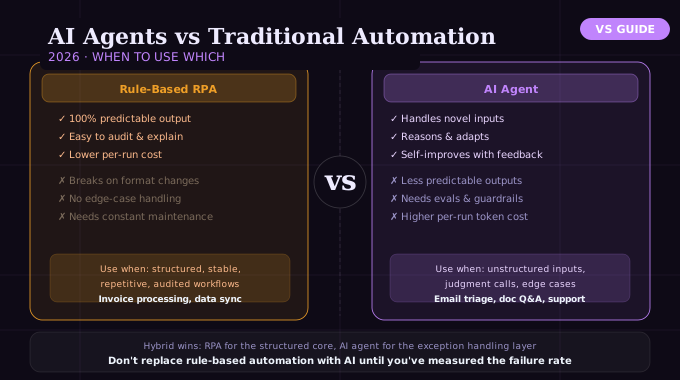
- 2Use LLM agents for fuzzy inputs, unstructured docs, or multi-step reasoning
- 3Agent costs are 10–100x higher per execution than scripted workflows
- 4Hybrid is usually right: agent for understanding, code for execution
2026 is the year every vendor slide deck calls their product an "AI agent." Most of those products are a thin chat wrapper around a workflow that a 50-line Python script could run more reliably and 100x cheaper. Agents are powerful — and badly mis-used. Here is a clean 2026 framework for deciding when an AI agent earns its cost, and when a deterministic workflow wins.
What an LLM agent actually is
An LLM agent is a model (Claude, GPT, Gemini, Llama, Mistral) given a goal, a set of tools (functions it can call), and the ability to plan, call tools, observe results, and re-plan until it succeeds or gives up. The value is non-deterministic reasoning over messy inputs. The cost is non-deterministic behaviour, higher latency, and per-call token billing.
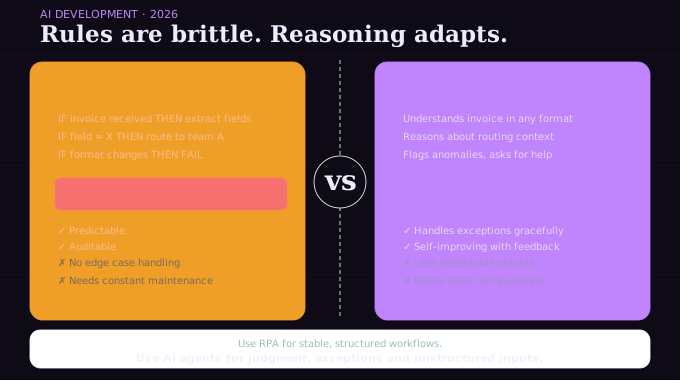
When deterministic automation wins
- The workflow is stable: same trigger, same steps, same outcome every time.
- Inputs are structured: JSON, CSV, a database row, a typed form submission.
- Reliability matters more than flexibility: invoice generation, payment processing, scheduled reports.
- Cost per execution must be predictable: 1 million runs/day at $0.0001 each is fine; 1 million LLM calls is a budget catastrophe.
For these, build a regular workflow: cron + Python, n8n, Temporal, Step Functions, or a typed event-driven pipeline. Boring. Reliable. Cheap.
When LLM agents earn their cost
- Inputs are unstructured: free-text emails, PDFs, voice transcripts, support tickets.
- The "right" answer requires judgement: triage, classification, summarisation, drafting responses.
- The workflow forks: different next steps depending on what the agent finds. Hard to enumerate as code; natural for a planner.
- The user wants natural language interaction: internal chat copilots, sales research agents, document Q&A.
Planning a Website? Don't Overpay or Underbuild
Most businesses overspend on features they don't need — or underspend and rebuild within a year. We help you scope it right from day one.
The hybrid pattern that almost always wins
Use the LLM where it earns its cost — understanding, classification, drafting — and use deterministic code for everything else. A typical mature pipeline looks like:
- Inbound email arrives.
- LLM classifies intent and extracts entities into a typed JSON object (Zod / Pydantic validated).
- Deterministic workflow takes over: routes to the right team, updates the CRM, drafts a response.
- LLM polishes the draft response in the brand voice.
- Human approves before send (or full auto for low-risk categories).
That pattern uses ~3 LLM calls per email instead of 30, costs cents instead of dollars, and is testable end-to-end.
The cost reality in 2026
- A deterministic Python step: $0.00001–$0.0001 per execution.
- A single LLM call (GPT-5-class, ~2K tokens): $0.01–$0.05.
- A full agent loop (5–15 tool calls, 20K tokens): $0.20–$2.00.
At scale that is the difference between a $50/month and a $50,000/month bill for the same workflow.
Reliability and observability
Agents fail in ways code does not. They hallucinate tool arguments. They loop. They make up data. You must instrument every tool call (Langfuse, Helicone, Arize), enforce schema validation on every output, set hard step limits, and gate destructive actions behind human approval. Build evals before you build the agent.
A 2026 decision checklist
Ask, in order:
- Can this be a database trigger or cron job? → Use that.
- Can this be a typed workflow with branching rules? → Use n8n / Temporal / Step Functions.
- Does the input require reading unstructured text/voice/images and making a judgement? → Add an LLM step inside the workflow.
- Does the task require multi-step planning where steps depend on intermediate findings? → Now you have earned an agent.
If you are scoping an AI initiative and unsure where the agent boundary should sit, contact us for an architecture review. See our dedicated AI development service and related IT consulting work.
Pro Insight
Planning a cloud-native platform? Let's review your architecture for free.
At ZANISS SOFTWARES, we don't just build websites — we build growth systems.
- ✓SEO-first architecture
- ✓Conversion-focused design
- ✓High-speed performance
- ✓Scalable, future-proof code
📩 Response within 24 hours