Infographic 8 · ZANISS SOFTWARES

How to Lower Cost Per Lead with SEO and Google Ads

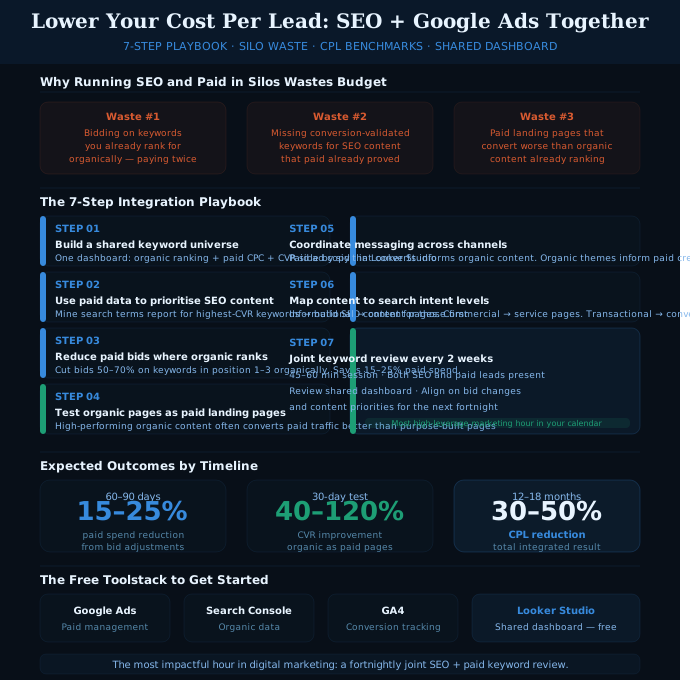
When SEO and Google Ads run in silos, you pay twice for the same query and miss the overlap that makes both cheaper. This page lays out the three-phase integrated playbook we use with clients to cut blended CPL by 50–70% over 18–24 months, with the conversion tracking and landing-page rules that make it work.

How to Lower Cost Per Lead with SEO and Google Ads — infographic by ZANISS SOFTWARES
How to Lower Cost Per Lead with SEO and Google Ads · Source: ZANISS SOFTWARES — free to share with credit and a link back to this page.

Key takeaways

  • Google Ads without an SEO foundation pays 40–80% more per click — Quality Score directly penalises low domain authority
  • Integrated SEO + Ads lowers blended CPL by 50–70% over 18–24 months
  • Landing page quality accounts for ~50% of Google Ads performance — a perfect Quality Score with a weak page still wastes budget
  • Retargeting visitors who found you organically through paid ads is one of the highest-ROI campaigns available
  • Most businesses overspend on broad-match and underspend on exact-match / phrase-match where intent and conversion rates are highest

Phase 1 — Immediate Pipeline With Google Ads (Months 1–3)

The integrated strategy begins with paid search on your highest-intent commercial keywords. Exact-match and phrase-match campaigns targeting bottom-of-funnel searches — 'hire custom software developer India', 'CRM development company Ahmedabad', 'mobile app development cost Mumbai' — generate qualified leads from day one. Broad-match campaigns waste budget on informational queries from people nowhere near a buying decision. Conversion tracking is non-negotiable from day one — without it, every optimisation decision is guesswork. Set up tracking for every meaningful action (form submissions, call clicks, consultation bookings) and connect to GA4 to see the full path from keyword to revenue.
Phase 2 — Build Organic Authority in Parallel (Months 1–12)

Organic SEO runs simultaneously with paid campaigns from month one — not after paid is established. Publish two to four long-form articles per month targeting informational and comparison keywords relevant to your services. This builds domain authority progressively, which has two simultaneous effects: it improves your organic rankings for high-intent keywords, and it improves your Google Ads Quality Score — directly reducing CPC on paid campaigns for the same keywords. The organic investment is front-loaded and returns are back-loaded: months 1–4 generate minimal direct organic traffic; months 5–12 see compounding growth as content accumulates authority.

Phase 3 — Reduce Paid Spend as Organic Scales (Months 12–24)

As organic rankings improve for high-intent keywords, paid spend on those terms is reduced and reallocated to new keyword clusters, competitor terms or geographic expansions. By month 18–24, the majority of traffic on core commercial terms is typically organic. Paid campaigns become a top-up mechanism, a testing environment for new offers, and a tool for capturing demand in markets where organic authority has not yet been built. The blended CPL after 24 months is typically 50–70% lower than month one — because the organic channel, with zero marginal cost per visitor, represents an increasing proportion of total lead volume. Landing-page quality is the most underdiscussed variable: page load under two seconds, message match between ad and headline, a single clear conversion action, and social proof relevant to the query type are the four factors that most reliably reduce CPL.

Frequently asked questions

What is a good cost per lead for B2B businesses?
B2B CPL varies significantly by industry and deal size. For software and technology businesses in India, a CPL of ₹500–₹2,000 from organic/SEO and ₹1,500–₹5,000 from Google Ads is generally considered healthy. What matters most is CPL relative to your average contract value — a ₹5,000 lead is excellent if it closes into a ₹5,00,000 project.
Does SEO or Google Ads give a lower cost per lead?
Mature SEO consistently delivers lower CPL than Google Ads because organic traffic has no per-click cost. However, SEO takes 3–9 months to build momentum. Google Ads delivers leads immediately but requires ongoing spend. The right answer is both — Ads fills the pipeline while SEO builds the long-term organic asset.
How long does SEO take to reduce cost per lead?
Meaningful CPL reduction from SEO typically takes 4–9 months, depending on competition, domain authority, and content volume. After 12 months of consistent SEO investment, most businesses see organic leads accounting for 40–60% of total pipeline — dramatically reducing blended CPL compared to running paid search alone.

Want this applied to your business?

Book a free consultation and we'll map this framework to your project — no fluff, no sales pressure.