Quick Summary
- 1QA is a leading indicator of engineering health — most 2026 outages trace back to a test that was never written.
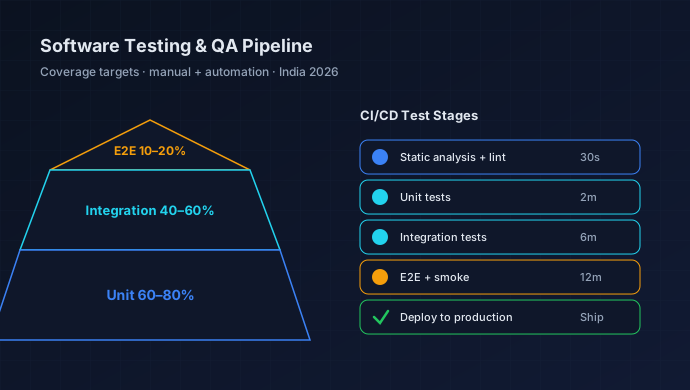
- 2Realistic coverage: 60–80% unit, 40–60% integration, 10–20% E2E — chasing 100% wastes money.
- 3India QA rates 2026: INR 45K–2.2 L / month per engineer depending on automation depth.
- 4Outsource exploratory + regression; keep contract tests and security tests close to the product team.
Every founder we speak to in 2026 says testing is important. Very few can tell us what their test coverage actually is, which tests run on every PR, or how many customer-facing bugs shipped in the last quarter. QA is the discipline that gets cut first when a deadline slips, and it is almost always the reason the next deadline slips harder.
Having built QA practices for Indian SaaS, fintech and healthtech teams — and audited more than a few where the entire test suite was three Postman collections — here is the 2026 reality of what modern QA looks like, what it costs in India, and where outsourcing helps versus hurts.
What "good QA" actually looks like in 2026
Modern QA is not headcount, it is a set of layered checks that run automatically on every change. The reference model we use with clients:
- Unit tests — fast, isolated, run on every save. Target 60–80% coverage on business-logic code; skip trivial getters.
- Integration tests — real database, real message bus, in-memory HTTP. Target 40–60% coverage of API contracts.
- End-to-end tests — Playwright or Cypress, run on every PR. Focus on the 15–25 user journeys that actually matter (checkout, signup, key workflows).
- Contract tests — Pact or OpenAPI diffing between services. Catch breaking changes before staging.
- Performance & security tests — k6 load runs and OWASP ZAP baseline scans in nightly CI.
- Exploratory sessions — a human tester spending 4–8 hours a week trying to break new features intentionally.
Chasing 100% coverage is a vanity metric — the last 10% of coverage typically catches 1% of bugs at 4× the maintenance cost. The hidden risks of tech debt post goes deeper on why coverage without prioritisation is theatre.
Manual vs automation — the honest split
Automation is not universally better. In 2026 the split we recommend for most Indian SaaS teams:
- Automate — regression, API contract, deployment smoke, cross-browser rendering, load, security baselines. These run without human attention and catch stable classes of bugs.
- Keep manual — exploratory testing of new features, usability, edge cases in complex domains (payments, medical, tax), accessibility with real assistive tech.
Teams that go 100% automated ship faster but miss the "this is technically working but obviously wrong" bugs that only a human catches. Teams that stay 100% manual burn out by 60 tenants.
Indicative QA engagement cost (India, 2026)
| Engagement Model | Price Range | Best For |
|---|---|---|
| Manual QA pod (3 engineers) | INR 1.4–2.4 L / month | Regression coverage, exploratory testing |
| Automation pod (2 SDETs + lead) | INR 3.5–6.5 L / month | CI/CD gates, E2E and API tests |
| Enterprise QA squad (6–10 mixed) | INR 9–20 L / month | Performance, security, compliance-heavy |
Planning a Website? Don't Overpay or Underbuild
Most businesses overspend on features they don't need — or underspend and rebuild within a year. We help you scope it right from day one.
What QA really costs in India, 2026
Rates have moved meaningfully in the last 18 months as SDET (software development engineer in test) roles matured. Ranges below are for engagements with an experienced Indian vendor:
- Manual QA engineer — INR 45K–90K / month, depending on domain expertise. Regulated domains (banking, health) trend higher.
- Automation engineer (Selenium / Playwright) — INR 90K–1.5 L / month. Should also be comfortable in CI/CD pipelines.
- SDET (writes production-grade test code) — INR 1.5–2.2 L / month. Rare, worth every rupee for critical systems.
- Performance / security specialist — INR 1.8–3 L / month or project-priced.
A typical Series A SaaS team of 12 engineers we scope lands around a 3-engineer QA pod at INR 3.5–5 L / month, split 1 SDET + 2 automation. Enterprise-grade compliance work (SOC 2, HIPAA, RBI) usually adds a specialist for 4–8 weeks per audit cycle.
What to outsource, what to keep in-house
The rule we hand every client: outsource repetitive coverage, keep close what changes with the product.
- Outsource — regression suite maintenance, exploratory testing waves before major releases, cross-browser and device farm runs, load-test setup, accessibility audits.
- Keep in-house — contract tests between your services, security posture (threat model updates, secret scans), the CI/CD pipeline itself, and any test that changes weekly with the product.
Outsourced testing wins on cost when scope is stable. It fails when the vendor is expected to keep pace with a fast-moving product roadmap without embedded contact with your engineers. Our IT consulting engagement usually starts with defining that boundary before writing any tests. See also our DevOps services guide for how QA and CI/CD fit together.
Common QA mistakes in 2026
- Buying test cases by the count — 2,000 tests that all pass tell you nothing if none exercise your actual risk. Prefer 200 tests that cover the top-15 user journeys.
- Flaky E2E suites — teams eventually ignore them, which is worse than having no tests. Budget dedicated engineering time to flake reduction, or delete flaky tests.
- QA sign-off as a phase — bugs found in a two-week "QA phase" cost 10–30× more than bugs caught in the same sprint they were written. Shift-left or accept the tax.
- No production monitoring — tests catch what you thought about. Real-user monitoring, error tracking (Sentry) and structured logs catch everything else.
Working with us
We build embedded QA pods, migrate test suites onto modern frameworks (Playwright, k6, Pact), and stand up CI/CD gates that block bad code from reaching production. Pair this with IT consulting and our software audit practice, then contact us for a free QA maturity assessment.
Pro Insight
Planning a cloud-native platform? Let's review your architecture for free.
At ZANISS SOFTWARES, we don't just build websites — we build growth systems.
- ✓SEO-first architecture
- ✓Conversion-focused design
- ✓High-speed performance
- ✓Scalable, future-proof code
📩 Response within 24 hours
Frequently Asked Questions
What test coverage percentage should a startup target?
Aim for 60–80% unit coverage on business-logic code, 40–60% integration coverage on your API surface, and coverage of your top 15–25 user journeys in end-to-end tests. Beyond that the marginal cost of coverage exceeds the marginal bug catch. Coverage is a hygiene metric, not a target to optimise.
Is outsourced QA in India worth it in 2026?
For stable regression, cross-browser, and exploratory sweeps — yes, and the India cost advantage is still 40–65% versus onshore rates. For contract tests, CI/CD pipeline work and security posture, keep the work close to the engineering team — the coordination cost of outsourcing fast-moving product work exceeds the labour savings.
Manual QA or fully automated QA — which is right for a SaaS product?
Both, in a rough 70/30 automated-to-manual split. Automate everything that is repetitive and deterministic (regression, contract, load). Keep humans in the loop for new-feature exploration, usability and edge cases in complex domains. Fully-automated pipelines ship fast but miss 'technically correct, obviously wrong' bugs a person catches instantly.