In this article
Quick Summary
- 1Jio switched on tiered business-RCS pricing in India in September 2026 — ₹0.27–₹0.30 for marketing messages, ₹0.25 for transactional messages, and ₹0.11–₹0.16 for OTPs, up from a flat ₹0.08–₹0.10 a year earlier. Airtel has partnered with Google to bring RCS onto its own network at a reported ₹0.11 per message, and Apple has started lighting up business RCS on iPhones in India through Jio. Compare that to WhatsApp Business API's October 2026 India rate card — ₹0.8631 per marketing message and ₹0.115 per utility or authentication message, plus BSP markup and 18% GST — and to plain DLT-registered SMS at roughly ₹0.08–₹0.18 per message, and the picture is clear: RCS is now meaningfully cheaper than WhatsApp for marketing-heavy sends, but its device and operator coverage in India is still catching up. This article breaks down the real numbers and gives a decision framework for which channel — or mix of channels — fits your business in 2026.
What RCS Business Messaging Actually Is
RCS (Rich Communication Services) is the GSM industry's replacement for SMS — it runs over the same "Messages" app already on most Android phones, but adds the things SMS never had: read receipts, typing indicators, high-resolution images and video, rich cards, product carousels, suggested-reply chips, and a verified sender badge with your business name and logo. Google has carried RCS in Google Messages since 2019, and by 2026 Google says the network handles roughly a billion RCS messages a day worldwide. What changed in 2026 is that it finally became a real India story: Jio, the country's largest carrier, switched on business-grade RCS pricing, Airtel signed a commercial deal with Google to do the same, and Apple began enabling business RCS for iPhone users in India through Jio — directly challenging WhatsApp's dominance of business messaging in the country for the first time.
The 2026 Rollout: Jio's Pricing, Airtel's Deal, and Apple on iPhone
Jio had been charging a flat ₹0.08–₹0.10 per business RCS message. In September 2026 it moved to a tiered rate card: ₹0.27–₹0.30 for marketing messages, ₹0.25 for transactional messages, and ₹0.11–₹0.16 for OTP messages — an increase Jio's own reporting describes as "around 10% to almost three times the earlier rate," depending on category. The timing lines up with Jio's partnership with Apple to bring business RCS to iPhones on its network, which went live the same month; Apple had already rolled out business RCS in the US, UK, Germany, France and Spain before extending it to India.
Airtel, meanwhile, struck a separate commercial deal with Google in December 2025 to offer RCS using Google's platform, reportedly at ₹0.11 per business message under an 80:20 revenue-share arrangement, after Google agreed to route Airtel's RCS traffic through Airtel's own spam filtering. As of late 2026, reporting is inconsistent about whether Airtel's and Vodafone Idea's rollouts are fully live for business senders or still in progress — treat any claim that "all major Indian carriers support RCS" with some caution until you've confirmed coverage with your own CPaaS provider. For now, Jio is the clear leader on the business side, with over 500 million subscribers on its network.
RCS vs WhatsApp Business API vs SMS: The Real Cost Comparison
Here is how the three channels actually compare on India pricing as of late 2026. WhatsApp's model also changed this year: Meta moved from charging per 24-hour conversation to charging per delivered template message on 1 July 2025, and from 1 October 2026 it also started charging for service replies beyond a free monthly allowance and for utility templates sent inside an already-open conversation window.
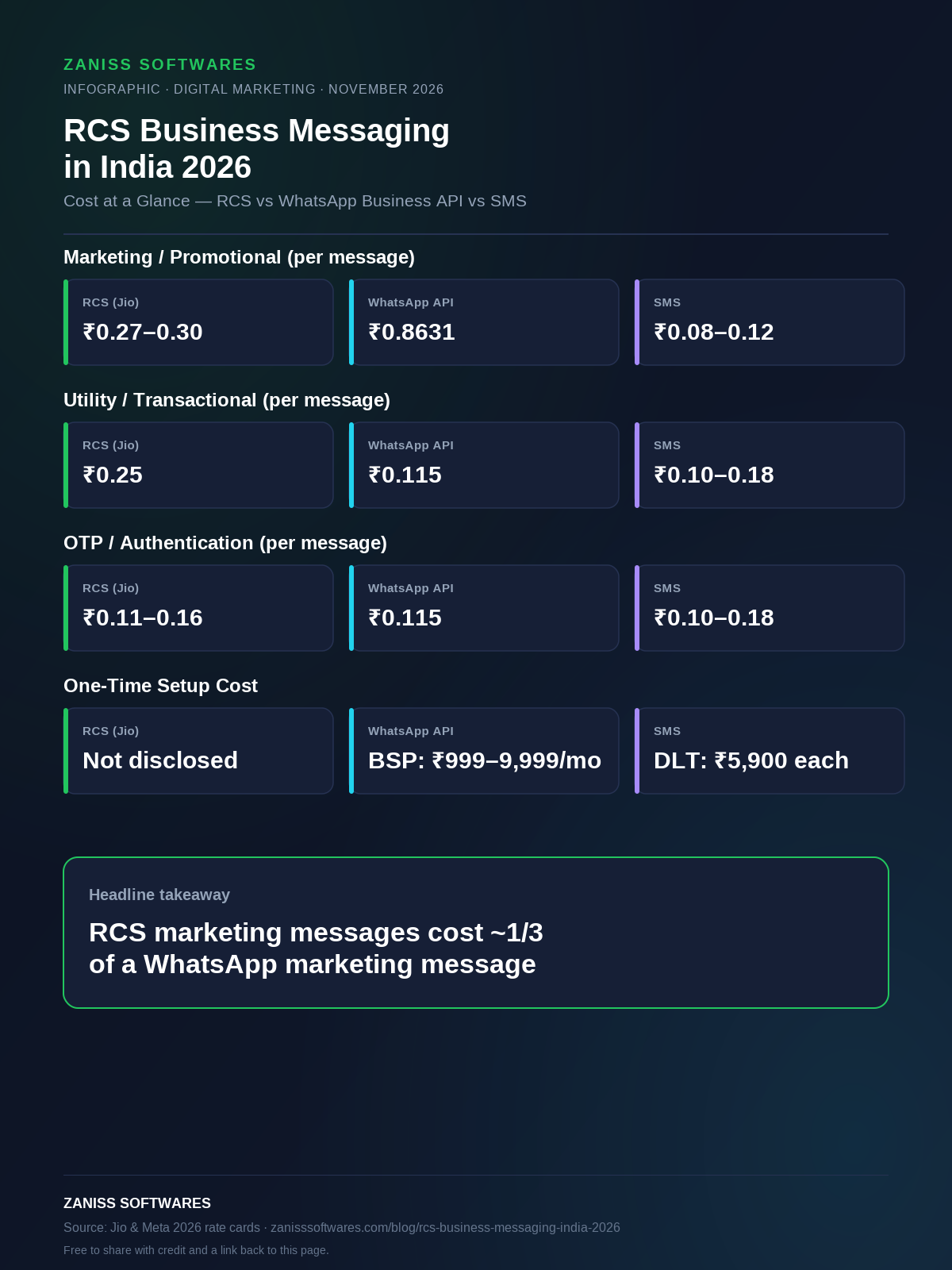
| Message Type | RCS (Jio, 2026 rate card) | WhatsApp Business API (Meta, Oct 2026 India rates) | SMS (DLT-registered) |
|---|---|---|---|
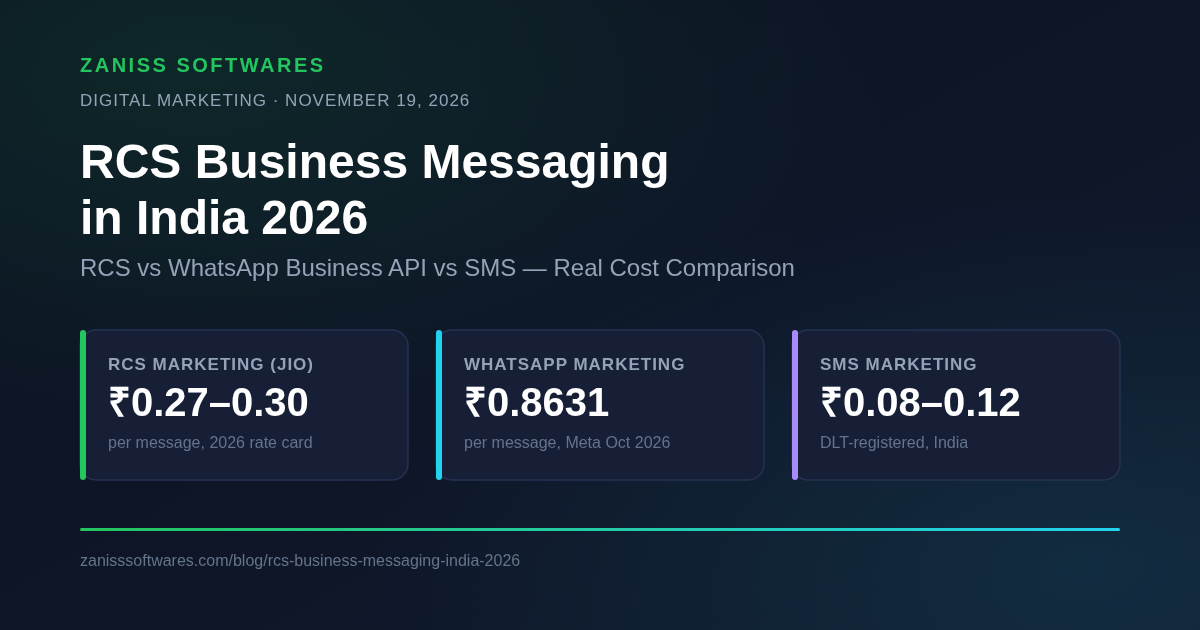
| Message TypeMarketing / promotional | RCS (Jio, 2026 rate card)₹0.27 – ₹0.30 | WhatsApp Business API (Meta, Oct 2026 India rates)₹0.8631 | SMS (DLT-registered)₹0.08 – ₹0.12 |
| Message TypeUtility / transactional | RCS (Jio, 2026 rate card)₹0.25 | WhatsApp Business API (Meta, Oct 2026 India rates)₹0.115 | SMS (DLT-registered)₹0.10 – ₹0.18 |
| Message TypeOTP / authentication | RCS (Jio, 2026 rate card)₹0.11 – ₹0.16 | WhatsApp Business API (Meta, Oct 2026 India rates)₹0.115 (₹2.4971 for international senders) | SMS (DLT-registered)₹0.10 – ₹0.18 (same route as transactional) |
| Message TypeService / support reply | RCS (Jio, 2026 rate card)Not separately metered by Jio yet | WhatsApp Business API (Meta, Oct 2026 India rates)Free for first 1,000/month, then ₹0.115 | SMS (DLT-registered)Not applicable — SMS has no reply concept |
| Message TypeOne-time setup | RCS (Jio, 2026 rate card)Not publicly disclosed; operator-set | WhatsApp Business API (Meta, Oct 2026 India rates)BSP onboarding ₹999 – ₹9,999/month + 18% GST on usage | SMS (DLT-registered)DLT entity registration + sender ID, ₹5,900 each |
A few things jump out. RCS marketing messages are roughly a third of the cost of a WhatsApp marketing template — real savings at any meaningful send volume. On OTPs, RCS and WhatsApp land in almost the same band, and both sit close to plain SMS, so cost alone won't decide that choice; reliability and reach will. And once you add a CPaaS/BSP markup on top of Meta's own rate — reporting puts effective WhatsApp marketing costs anywhere from roughly ₹0.95 to over ₹2 per message depending on provider — the RCS cost advantage for marketing gets even larger on paper. The catch is reach: RCS today works on Android handsets with carrier and Google Messages support, and only recently started working for iPhone users on Jio specifically, while WhatsApp already has well over 500 million users in India across every device and network.
What RCS Can Do That SMS Can't
RCS messages can carry rich cards and product carousels, clickable call-to-action buttons, suggested-reply chips that let a customer respond with a single tap, a verified sender identity showing your business name and logo instead of a random ten-digit number, and delivery and read receipts — all inside the same "Messages" app a customer already has open, with no download required. That combination is why marketers are watching RCS closely: it brings most of WhatsApp's rich-media toolkit to a channel that, unlike WhatsApp, doesn't require the customer to have opted in to a separate app or given up a phone number to a messaging platform they don't control.
Where RCS Still Falls Short of WhatsApp
Three gaps matter in 2026. First, coverage: RCS availability still depends on the customer's device, operating system, and carrier, so delivery is less universal than SMS and less consistent than WhatsApp, which runs over the internet on any smartphone. Second, ecosystem maturity: WhatsApp has years of template approval workflows, chatbot platforms, and customer-support tooling built around it; RCS tooling in India is newer and thinner. Third, template-approval friction cuts the other way too — RCS vendors pitch it as a WhatsApp fallback precisely because it isn't gated by Meta's template-approval process, which is a real advantage when a WhatsApp template gets rejected or delayed, but it also means RCS lacks the predictability that approved WhatsApp templates give larger, compliance-sensitive senders like banks and fintechs.
Decision Framework: Which Channel Fits Your Business
Match the channel to what you're actually sending, not to whichever one is cheapest on paper.
High-volume marketing and promotional campaigns to an Android-heavy, Jio-heavy customer base: RCS is worth piloting now. At ₹0.27–₹0.30 versus ₹0.86+ on WhatsApp, the savings at scale are real, and rich cards and carousels give you most of WhatsApp's visual toolkit.
Transactional alerts, OTPs, and anything compliance-sensitive (banking, lending, healthcare): stay on SMS and WhatsApp as your primary rails for now, and treat RCS as a parallel channel to test rather than a replacement. Coverage gaps on non-Jio networks and older devices are a real operational risk until Airtel's and Vodafone Idea's rollouts are confirmed live for business senders.
Customer support and rich two-way conversations: WhatsApp Business API remains the stronger default in 2026 because of its size, its bot and CRM ecosystem, and its near-universal reach across devices and networks — RCS is a useful cost-saver for outbound marketing blasts, not yet a replacement for a support channel your whole customer base can reach.
Already running WhatsApp Business API at scale: don't rip anything out. Add RCS as a lower-cost channel for marketing sends to the Android/Jio segment of your base, route by device/carrier where your CPaaS provider supports it, and keep WhatsApp and SMS as the fallback for everyone else.
How ZANISS Builds a Messaging Stack That Doesn't Lock You Into One Channel
The businesses getting the most out of this shift aren't picking RCS or WhatsApp — they're building a messaging layer that routes each message to the cheapest channel that will actually reach that customer, with SMS as the guaranteed fallback. That means an abstraction layer over your CPaaS provider's APIs (Gupshup, Infobip, Kaleyra, MSG91, Route Mobile and others all now offer RCS alongside WhatsApp and SMS), delivery-receipt handling that can detect an RCS failure and retry on WhatsApp or SMS automatically, and analytics that tell you the true cost per converted customer across all three channels — not just the sticker price per message. Our Digital Marketing team builds and runs exactly this kind of multi-channel messaging strategy, and where it needs custom integration work — a routing engine, a CRM-linked messaging API, or a fallback engine that switches channels automatically — our Custom Software Development practice builds it as part of the same engagement.
Frequently Asked Questions
Is RCS actually cheaper than WhatsApp Business API in India in 2026?
For marketing messages, yes — Jio's 2026 RCS marketing rate of ₹0.27–₹0.30 per message is roughly a third of Meta's ₹0.8631 WhatsApp marketing rate, before either side's provider markup. For OTPs and utility messages, the two channels are close enough in price (₹0.11–₹0.16 for RCS, ₹0.115 for WhatsApp) that reach and reliability should decide, not cost.
Which Indian telecom operators support RCS business messaging right now?
Jio is live with published business RCS pricing as of September 2026 and is the clear leader, with Apple's business RCS also live for iPhone users on Jio's network. Airtel signed a commercial deal with Google in December 2025 to bring RCS onto its network, and Vodafone Idea has been reported as supporting or preparing to support RCS. Coverage claims vary by source, so confirm current status with your CPaaS provider before committing budget to an RCS-first campaign.
Do I need a CPaaS provider to send RCS messages, or can I go direct with each carrier?
In practice, almost every business sends RCS (and WhatsApp and SMS) through a CPaaS/BSP provider rather than integrating with each telecom operator separately. Providers active in the India RCS market include Gupshup, Infobip, Sinch, Netcore Cloud, MSG91, Route Mobile, Tata Communications Kaleyra and others — most quote custom or volume-based pricing rather than publishing a flat rate.
Will RCS replace SMS OTPs for my app?
Not yet, and probably not soon. RCS OTP pricing is close to SMS pricing, but SMS still has the most universal device and network coverage in India, including on devices and networks where RCS business messaging isn't yet supported. The safer pattern for 2026 is to attempt RCS or WhatsApp first where available and fall back to SMS automatically, rather than switching OTP delivery to RCS outright.
How much does it cost to set up RCS messaging for my business?
Jio and Airtel haven't published a public one-time setup fee the way DLT registration for SMS has one (₹5,900 per sender ID through most operators). In practice your cost is the CPaaS provider's onboarding and monthly platform fee — typically in the same ₹999–₹9,999/month range as WhatsApp BSP plans — plus per-message usage at the rates above. Budget a short technical integration phase (1–3 weeks) if you want automatic channel fallback between RCS, WhatsApp and SMS rather than a single hard-coded channel.
Companion infographic: RCS Business Messaging in India 2026 — Cost at a Glance →
Related Articles
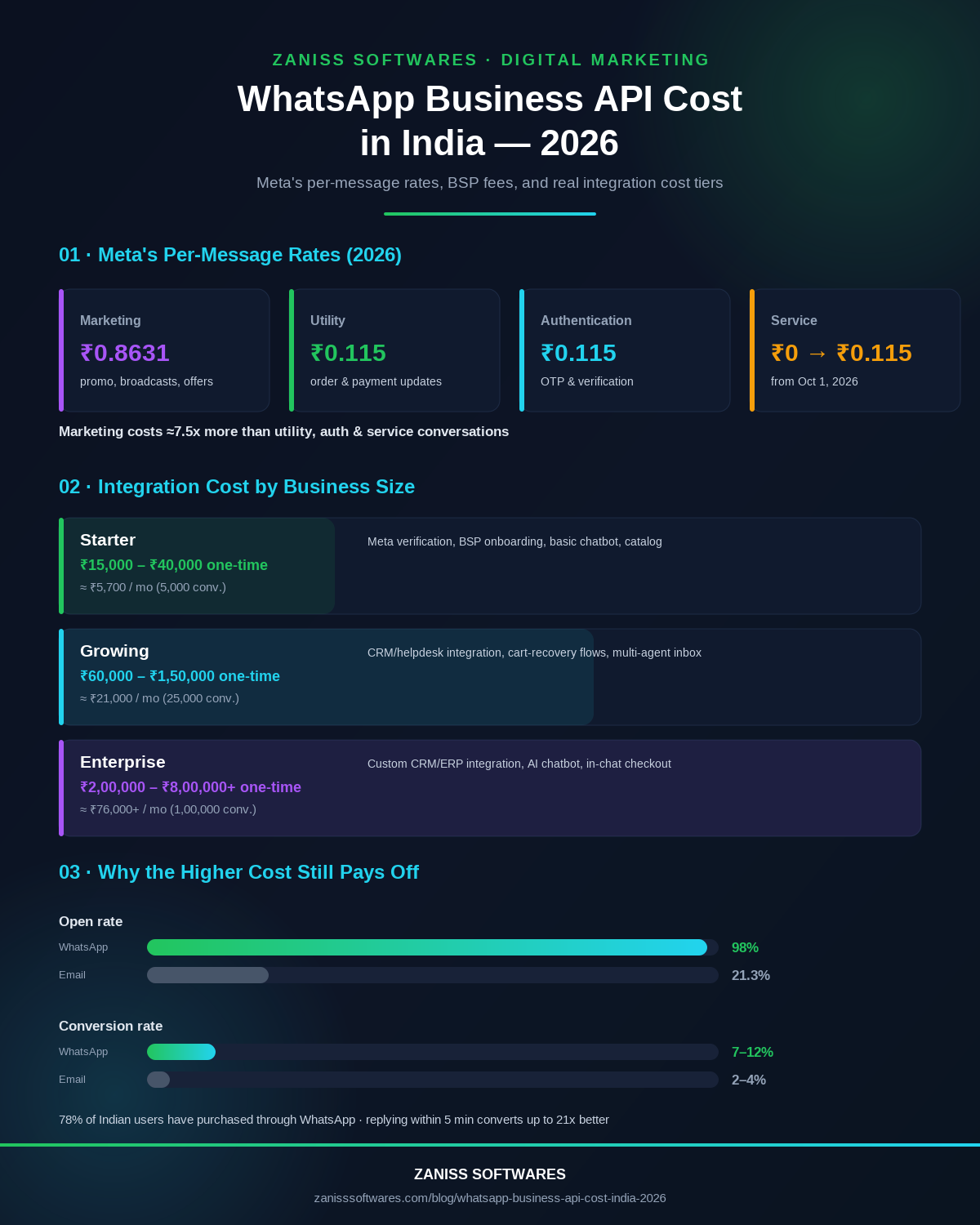
- WhatsApp Business API Integration Cost for Indian Businesses in 2026
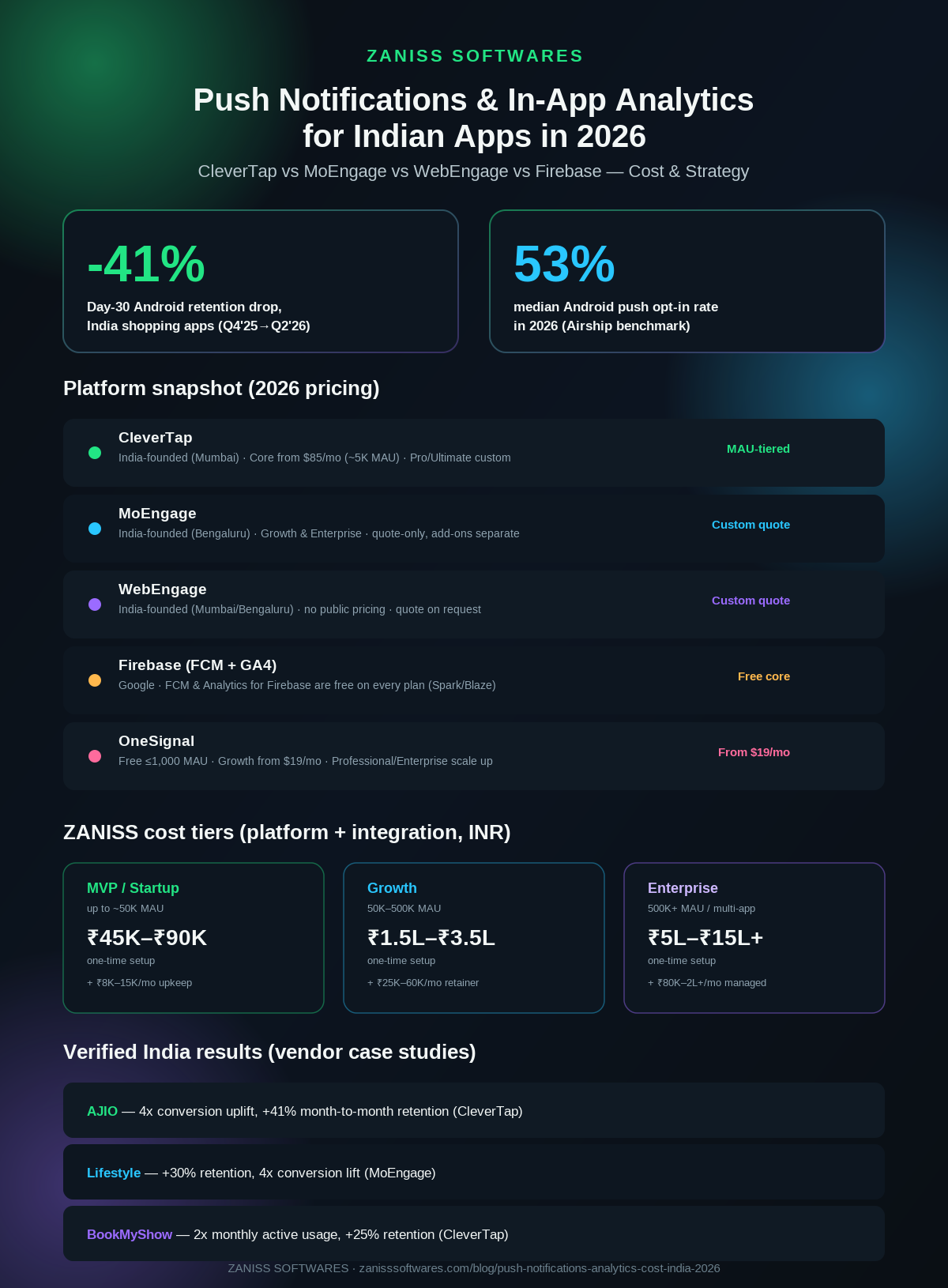
- Push Notifications & In-App Analytics for Indian Mobile Apps in 2026: CleverTap vs MoEngage vs WebEngage vs Firebase — Cost & Strategy
- AI-Powered Customer Support in India 2026: Chatbot vs AI Agent vs Human Handoff
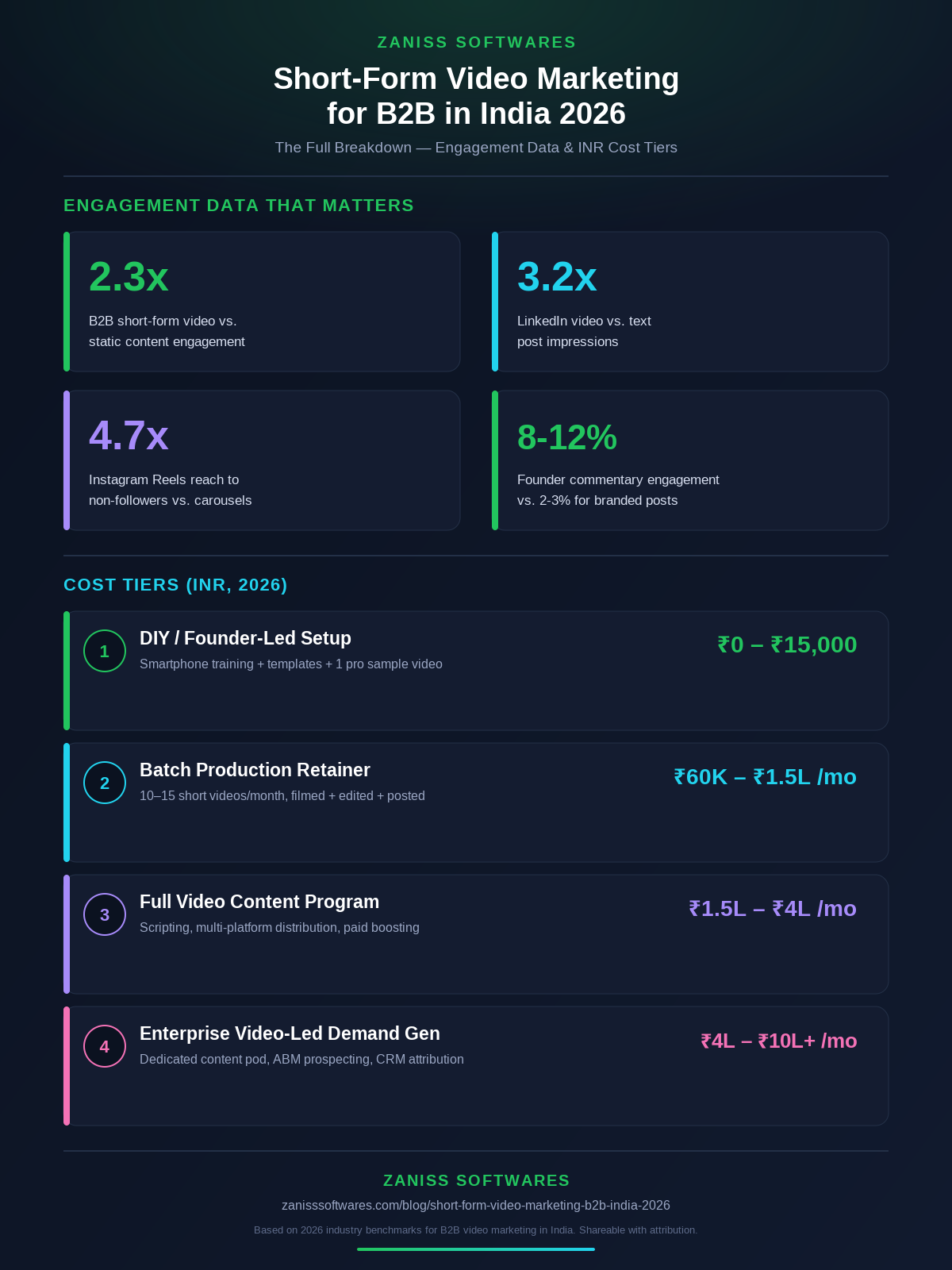
- Short-Form Video Marketing for B2B Companies in India in 2026: Cost, Strategy & ROI
Working With Us
Deciding between RCS, WhatsApp and SMS — or building a messaging stack that automatically routes between all three — is exactly the kind of engagement our Digital Marketing team runs every week for Indian businesses. Book a free consultation and we'll map your current messaging spend against the 2026 RCS, WhatsApp and SMS rate cards and tell you exactly where you can cut cost without losing reach.
📩 Response within 24 hours