In this article
Quick Summary
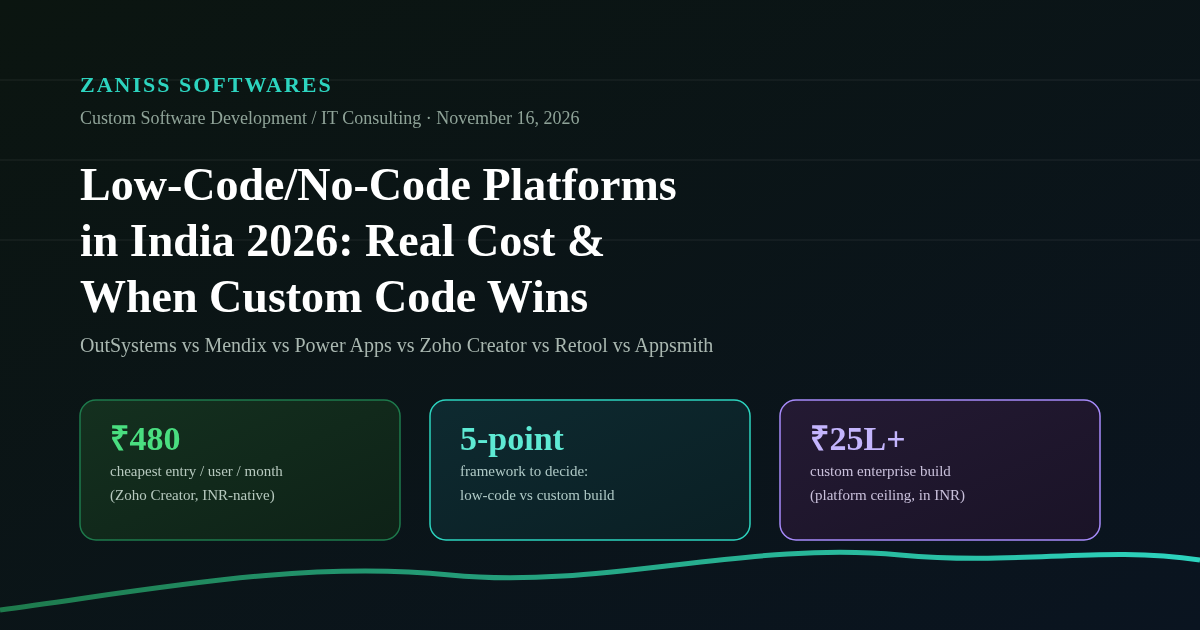
- 1Low-code and no-code platforms let Indian businesses ship internal tools and customer-facing apps without a full engineering team — but "faster and cheaper" only holds true up to a point. In 2026, Zoho Creator remains the lowest-cost entry for Indian SMEs at ₹480–₹2,220 per user/month (billed in INR), Microsoft Power Apps suits teams already on Microsoft 365 at roughly ₹1,130–₹1,880 per user/month, and enterprise platforms like Mendix (₹1.02L–₹2.56L/month flat) and OutSystems (custom-quoted, commonly ₹6L–₹76L+/year depending on scale) solve governance problems that developer-led platforms like Retool and Appsmith don't try to. The real decision isn't "low-code vs custom code" — it's matching the platform's abstraction level to how complex, how regulated, and how long-lived your application needs to be. This guide breaks down real 2026 pricing, a 5-point decision framework, and the point at which every low-code build should have already become a custom one.
Why Every Indian CTO Is Being Asked About Low-Code Right Now
Walk into any founder or IT-leadership conversation in India in late 2026 and low-code comes up within the first ten minutes — usually framed as a question, not a pitch: "Can't we just build this in Power Apps instead of hiring a dev team?" The pressure is real. Engineering salaries in India's tier-1 cities have climbed steadily, procurement teams want faster time-to-value, and every SaaS vendor from Zoho to Microsoft to Salesforce is marketing "citizen development" as the answer to backlog-starved IT departments.
The honest answer is: sometimes, yes. Low-code platforms genuinely solve a real problem — internal approval workflows, field-service forms, inventory dashboards, simple customer portals — faster and cheaper than briefing a developer, writing a spec, and waiting six weeks for a sprint. But the same platforms that feel liberating at 10 users and one app start charging enterprise prices, hitting governance walls, and generating "shadow IT" risk the moment a business tries to scale them past their design envelope. We've been called in by more than one Indian business this year to rescue a low-code build that outgrew its platform — and every single rescue cost more than if the business had scoped the build correctly from day one.
This guide is not a sales pitch for custom development dressed up as objective advice. It's the pricing data, the real trade-offs, and the decision framework we use with our own clients before recommending a platform, a hybrid build, or a fully custom application.
What "Low-Code" and "No-Code" Actually Mean in 2026
The terms get used loosely, so it's worth separating them before comparing cost:
No-code platforms (think Zoho Creator's drag-and-drop mode, Microsoft Power Apps' canvas apps) are built for business users with zero programming background. You design screens visually, wire up logic with formulas or flow-builder nodes, and the platform generates the runtime behind the scenes. Ceiling: anything requiring custom algorithms, non-standard integrations, or performance at real scale.
Low-code platforms (Mendix, OutSystems, and to a lesser extent Power Apps' model-driven apps) give trained developers a visual canvas plus an escape hatch into real code — custom JavaScript actions, custom connectors, custom business logic modules. They're built for IT departments, not individual business users, and they come with enterprise governance (environments, version control, role-based access, audit trails) that no-code tools generally lack.
Developer-first internal-tool builders (Retool, Appsmith, Tooljet) sit in a third category: they assume a developer is building the tool, but skip the boilerplate of wiring up a database, auth, and a UI from scratch. They're priced and positioned for engineering teams building admin panels and ops dashboards, not business users building customer-facing apps.
Mixing these up is the single most common reason a low-code project in India goes over budget — a business user starts an app in Zoho Creator assuming it can later "scale like Mendix," and discovers the two platforms don't share a migration path.
2026 Pricing: What These Platforms Actually Cost in India
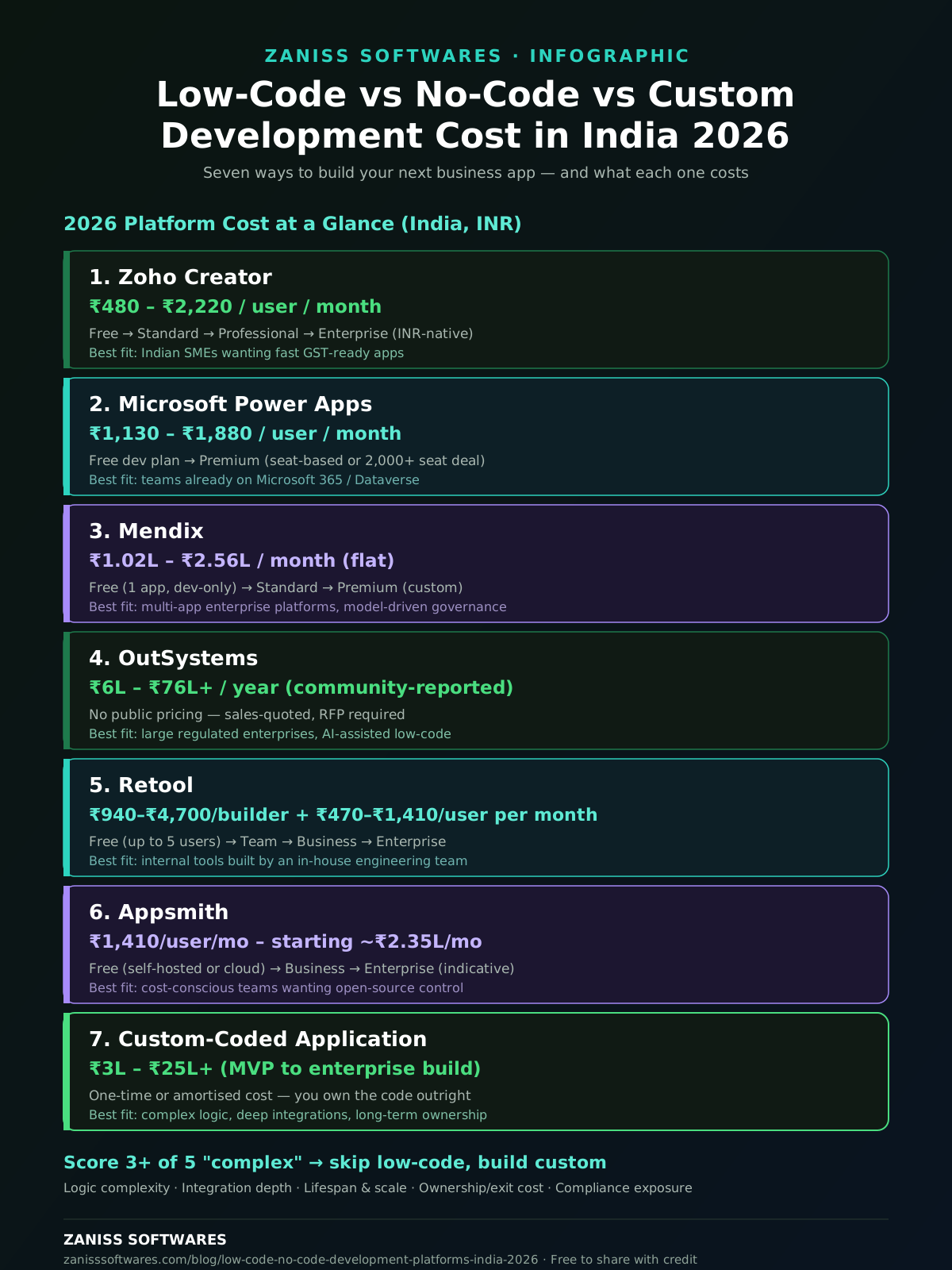
Pricing is where most comparisons go wrong, because vendors quote US dollar list prices that don't map cleanly to Indian buying patterns — per-user models punish growing teams, flat platform fees punish small ones, and at least one major vendor in this list refuses to publish pricing at all. Here's what each platform costs as of November 2026, converted to INR at roughly ₹94/USD where the vendor only lists USD.
| Platform | Entry-level cost | Mid-tier / team cost | Enterprise cost | Best fit |
|---|---|---|---|---|
| PlatformZoho Creator | Entry-level costFree (1 basic app) | Mid-tier / team cost₹480–₹1,800/user/month (Standard–Professional, INR, annual billing) | Enterprise cost₹1,500–₹2,220/user/month (Enterprise) | Best fitIndian SMEs wanting INR billing and fast GST-ready workflow apps |
| PlatformMicrosoft Power Apps | Entry-level costFree (Developer plan, build/test only) | Mid-tier / team cost~₹1,880/user/month (Premium, pay-per-user) | Enterprise cost~₹1,130/user/month at 2,000+ seat commitment (sales-negotiated) | Best fitTeams already standardised on Microsoft 365 / Dataverse |
| PlatformMendix | Entry-level costFree (1 app, dev-only, no SLA) | Mid-tier / team cost~₹1.02 lakh/month flat (Standard, One App) | Enterprise cost~₹2.56 lakh/month flat (Standard, Unlimited Apps) or custom (Premium, 24/7 SLA) | Best fitMulti-app enterprise platforms needing model-driven governance |
| PlatformOutSystems | Entry-level costFree (Personal Edition, up to 100 internal users, dev/test only) | Mid-tier / team costNot publicly listed — sales-quoted | Enterprise costCommunity-reported ₹6 lakh–₹76 lakh+/year depending on scale (not vendor-confirmed; OutSystems does not publish prices) | Best fitLarge regulated enterprises needing AI-assisted, full-stack low-code with formal governance |
| PlatformRetool | Entry-level costFree (up to 5 users) | Mid-tier / team cost₹940/builder + ₹470/user per month (Team) | Enterprise cost₹4,700/builder + ₹1,410/user per month (Business) or custom (Enterprise) | Best fitInternal tools and ops dashboards built by an in-house engineering team |
| PlatformAppsmith | Entry-level costFree (cloud or self-hosted, up to 5 users) | Mid-tier / team cost~₹1,410/user/month (Business) | Enterprise costStarting ~₹2.35 lakh/month (indicative; Enterprise is sales-quoted) | Best fitCost-conscious teams wanting open-source control and self-hosting |
| PlatformCustom-coded application | Entry-level cost₹3L–₹8L (scoped MVP) | Mid-tier / team cost₹8L–₹25L (departmental system) | Enterprise cost₹25L+ (multi-module enterprise build) | Best fitComplex business logic, IP ownership, or scale beyond platform limits |
A few things jump out once the numbers are side by side. First, Zoho Creator's INR-native pricing is a genuine advantage for Indian buyers — no currency-conversion guesswork, GST is simply added on top, and the Standard plan at roughly ₹480/user/month (annual billing) is cheaper than most companies' chai budget. Second, Mendix and OutSystems are not SME tools: Mendix's cheapest paid tier already runs over ₹1 lakh a month flat, and OutSystems' refusal to publish pricing is itself a signal — vendors who negotiate deal-by-deal usually do so because list price would scare away smaller buyers. Third, and most overlooked: the "custom-coded application" row isn't automatically the most expensive option once you're past roughly 50–100 users or multiple interconnected apps — platform license fees compound monthly, forever, while a custom build is a cost you can amortise and actually own.
The Hidden Costs No Platform Quote Includes
Every comparison above is license cost alone. In practice, Indian businesses adopting low-code in 2026 are also paying for:
- Integration connectors. Most platforms charge extra — or require a higher tier — to connect to Tally, SAP, custom ERPs, or India-specific payment rails like UPI and NEFT. Budget ₹50,000–₹3L depending on system complexity.
- Governance and citizen-developer oversight. The moment more than one business team starts building apps on the same platform, someone in IT needs to own environment management, access control, and app sprawl — typically 0.25–0.5 FTE of a senior engineer's time.
- Migration risk. Zoho Creator apps don't port to Mendix; Power Apps canvas apps don't port to OutSystems. If the platform choice turns out wrong, the rebuild cost is effectively the full original build cost again.
- Performance ceilings. Low-code runtimes add abstraction overhead. Apps with heavy computation, large file processing, or high concurrent load frequently need a custom service built alongside the low-code front end — which means you're paying for both.
- Data residency and DPDP Act compliance. Several of these platforms host data outside India by default. Confirming data residency, encryption, and consent-management configuration to match India's Digital Personal Data Protection Act adds a compliance review most teams skip until an audit forces it.
The 5-Point Decision Framework We Use With Clients
Before recommending low-code, developer-first tools, or a fully custom build, we score the project on five dimensions. A project that scores "custom" on three or more of these should not be built on a low-code platform, regardless of how fast the demo looked.
- Business logic complexity. Is the core value of this app a simple form-and-approval flow, or does it involve non-standard calculations, conditional pricing, multi-party workflows, or algorithms that don't map to a visual builder's primitives? Complex logic belongs in code.
- Integration depth. Does it need to talk to more than two or three external systems, especially India-specific ones (GSTN, UPI, Aadhaar e-KYC, DigiLocker)? Each additional integration erodes the speed advantage that justified low-code in the first place.
- Expected lifespan and scale. Is this a six-month pilot, or the system of record your business will run on for the next five years with 10x the users? Platforms that are cheap at pilot scale are rarely cheap at production scale.
- Ownership and exit cost. If you stopped paying the platform vendor tomorrow, what happens to the app and the data? Custom code is yours outright; a low-code app is a configuration that only runs inside someone else's runtime.
- Governance and compliance exposure. Does the app touch financial data, personal data under DPDP, or regulated workflows (lending, healthcare, insurance)? These need audit trails and data-residency guarantees that only enterprise-tier low-code (or custom code) actually delivers — free and mid-tier plans almost never do.
Score it honestly: one or two "custom" answers usually means a hybrid approach — build the simple interface in Zoho Creator or Power Apps, but have a developer build the one genuinely complex integration or calculation engine as a proper API the low-code app calls into. Three or more "custom" answers means skip the low-code detour entirely; you'll pay for it twice otherwise.
Where We See Low-Code Genuinely Winning in India Right Now
To be fair to the platforms: we've recommended Zoho Creator and Power Apps outright to clients this year, and we'd do it again. The clearest wins are internal approval workflows (leave, expense, purchase-order), field-data-collection apps for distributed teams, simple customer-facing booking or enquiry forms, and anything that needs to exist in under four weeks as a genuine pilot before a business commits budget to a fuller build. If your app fits in one of those buckets and stays there, a low-code platform will almost always beat a custom build on total cost of ownership for the first 12–18 months.
Companion infographic: Low-Code vs No-Code vs Custom Development Cost in India 2026 →
See the visual cost breakdown at https://zanisssoftwares.com/infographics/low-code-no-code-development-platforms-india-2026
Frequently Asked Questions
Is low-code actually cheaper than custom software development in India?
Only up to a point. For a single app with under 50 users and simple logic, platforms like Zoho Creator or Power Apps are almost always cheaper for the first year or two. Past that scale — multiple apps, heavy integrations, or a growing user base — monthly per-user and per-app licence fees compound indefinitely, while a custom build is a one-time (or amortised) cost you own outright. Run the 5-point framework above before assuming either answer.
Which low-code platform is best for an Indian SME — Zoho Creator or Power Apps?
If your team has no particular Microsoft dependency, Zoho Creator is usually the better starting point for Indian SMEs: it bills natively in INR, its entry tiers are meaningfully cheaper, and its support and documentation are already tuned for Indian GST and compliance workflows. Power Apps becomes the better choice specifically when your business already runs on Microsoft 365 and Dataverse, because the integration and licensing overlap pays for itself.
Can low-code platforms handle India-specific compliance like GST e-invoicing or the DPDP Act?
Partially, and it depends heavily on the plan tier. GST-adjacent workflow logic (approvals, basic calculations, reporting) is well within what Zoho Creator or Power Apps can do natively. Full GST e-invoicing (IRN/IRP integration) and DPDP Act-grade data residency, consent management, and audit logging typically require either an enterprise-tier plan with India data-hosting options, or a custom integration layer sitting alongside the low-code app — rarely something the free or mid-tier plans deliver out of the box.
What actually happens when a low-code app outgrows its platform?
In practice: performance degrades first (slow load times under concurrent use), then feature walls appear (the platform can't express the next piece of logic you need), then cost spikes (you're pushed into the enterprise tier to get the headroom you need). At that point the realistic options are a costly re-platform to a heavier low-code tool (e.g., Zoho Creator to Mendix), or a rebuild in custom code — which is why scoping the five-point framework correctly before you start saves the rebuild entirely.
Is OutSystems worth considering for an Indian business, given it doesn't publish pricing?
OutSystems is a genuinely capable enterprise platform with strong AI-assisted development features, and large regulated enterprises with complex, multi-app portfolios do get real value from it. But the lack of published pricing means every Indian business evaluating it needs a formal RFP process and multiple vendor quotes before committing — community-reported figures range from roughly ₹6 lakh/year for small deployments to ₹75 lakh+/year at enterprise scale, and those numbers should be treated as a starting point for negotiation, not a quote.
Related Articles
- Custom Software vs Ready-Made Software: Which Is Right for Your Business in 2026?
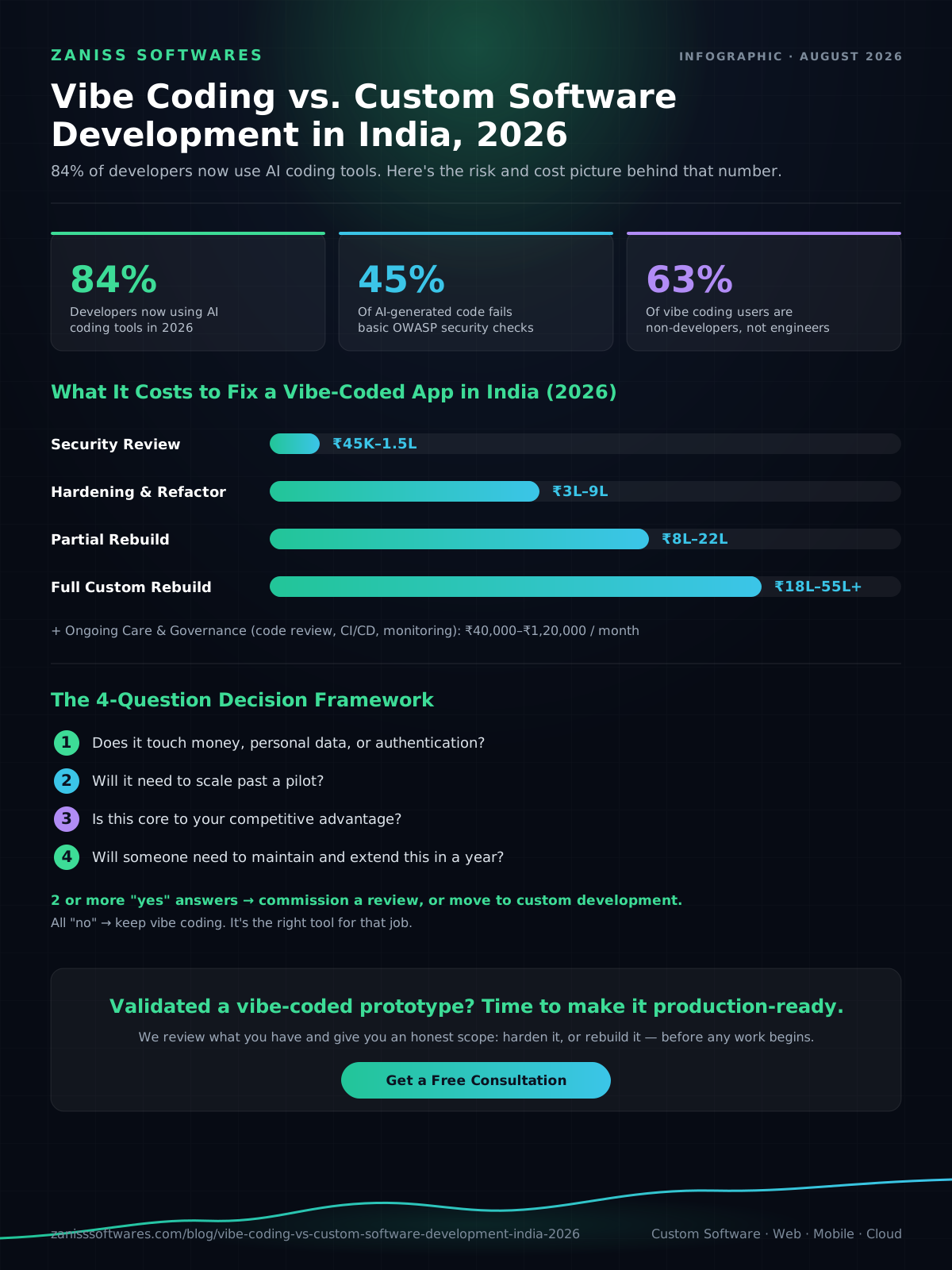
- Vibe Coding vs. Custom Software Development: What Indian Businesses Need to Know in 2026
- SaaS MVP Cost and Timeline in 2026: A Founder's Honest Guide
- The discovery sprint that saves 6 months of wasted code
Companion infographic: Low-Code vs No-Code vs Custom Development Cost in India 2026 →
Working With Us
Not sure whether your next build belongs on a low-code platform or needs a custom engineering team? We run this exact 5-point framework as part of every Custom Software Development engagement — scoping the app honestly before quoting it, so you don't pay for a rebuild in 12 months.
📩 Response within 24 hours